
What is a building blueprint? 30% rework guide for Florida

Building blueprints often spark confusion among homeowners and small business owners in Florida, leading to expensive rework that can consume up to 30% of project budgets. These detailed technical drawings serve as the primary reference for construction, permitting, and renovations, yet many people struggle to interpret them correctly. Understanding what blueprints truly represent and how to use them effectively prevents costly mistakes and ensures your project meets Florida’s strict building codes. This guide explains exactly what building blueprints are, how to read them confidently, and the Florida-specific requirements you need to know before breaking ground.
Table of Contents
- Key takeaways
- What is a building blueprint and why is it important?
- Key components and reading methods of building blueprints
- Unique Florida considerations for building blueprints
- Common pitfalls and expert tips for using building blueprints confidently
- Explore expert engineering services for your Florida construction projects
- What is a building blueprint? Frequently asked questions
Key Takeaways
| Point | Details |
|---|---|
| Blueprint purpose | Building blueprints communicate design intent dimensions materials and specifications and serve as the primary reference for construction. |
| Florida code focus | Blueprints in Florida must show hurricane wind loads flood considerations and compliance with the Florida Building Code to avoid permit delays. |
| Misread consequences | Misreading blueprints can lead to up to 30 percent rework and higher project costs. |
| Reading essentials | Know where to find the title block legend scales dimensions and notes to interpret plans accurately. |
What is a building blueprint and why is it important?
A building blueprint is a detailed technical drawing that communicates design intent, dimensions, materials, and specifications for construction projects, serving as the primary reference for builders. These comprehensive documents translate architectural vision into actionable construction instructions that coordinate every trade involved in your project. Without accurate blueprints, builders, electricians, plumbers, and inspectors would lack the unified reference needed to execute your vision correctly.
Blueprints serve multiple critical functions beyond simple construction guidance:
- They establish the legal framework for building permits and inspections
- They document structural integrity requirements and load calculations
- They specify exact material types, grades, and installation methods
- They communicate code compliance measures to regulatory authorities
For Florida homeowners and small business owners, understanding blueprints becomes especially important because misreading causes up to 30% rework and increases project costs by 5-12%. These errors typically stem from misinterpreting dimensions, overlooking revision notes, or missing critical structural details. When contractors build based on incorrect blueprint readings, the resulting work must be demolished and rebuilt, wasting materials, labor, and time.
Florida’s unique building environment adds another layer of complexity. Your blueprints must clearly demonstrate compliance with hurricane wind loads, flood zone requirements, and the Florida Building Code’s strict safety standards. Permit reviewers scrutinize these documents carefully, and any ambiguity or non-compliance triggers delays, revision requests, or outright denials. By learning to read and verify your blueprints before construction begins, you protect your investment and ensure your project proceeds smoothly through permitting and construction phases. Understanding construction blueprint basics empowers you to ask informed questions and catch potential issues early.
Key components and reading methods of building blueprints
Every blueprint contains standardized elements that convey specific information about your construction project. The title block appears in the lower right corner of each sheet, displaying project name, address, sheet number, scale, revision dates, and the architect or engineer’s stamp. This section serves as your first reference point when examining any blueprint sheet. The legend or symbol key explains the graphical representations used throughout the drawings, showing how doors, windows, electrical fixtures, plumbing elements, and structural components appear on the plans.
Key components include title block, legends, scales, line types, dimensions, notes, and sectional views that work together to communicate complete construction information. Common scales for residential projects use 1/4 inch equals 1 foot for floor plans, while commercial projects often employ 1/8 inch equals 1 foot to fit larger spaces on standard sheets. Line types distinguish between different elements: thick solid lines typically indicate walls in plan view, dashed lines show hidden or overhead features, and thin lines represent dimension strings or non-structural elements.
Dimension lines provide the most critical measurements for construction. These lines feature arrows or tick marks at each end, with the measurement displayed above or within the line itself. Construction notes appear as text callouts that specify materials, installation methods, or special requirements that drawings alone cannot convey. Section cuts reveal vertical slices through the building, showing floor-to-ceiling relationships, foundation details, and roof construction that plan views cannot illustrate.
Mastering blueprint reading requires a systematic approach:
- Start with title block and sheet index to understand project scope and drawing organization
- Verify the scale and review the symbol legend before examining details
- Study floor plans first to grasp overall layout and room relationships
- Cross-reference related sheets to understand how systems connect
- Use an architect’s scale ruler to verify critical dimensions
Pro Tip: Always trust written dimensions over scaled measurements. Even slight printing variations or paper expansion can throw off scale readings, but dimension callouts remain accurate regardless of reproduction quality.
Thicker lines on floor plans often indicate load-bearing walls that support structural loads from above. Removing or modifying these walls without proper engineering analysis can compromise building safety. Understanding blueprint reading techniques helps you identify these critical elements and communicate effectively with contractors about structural constraints.
Unique Florida considerations for building blueprints
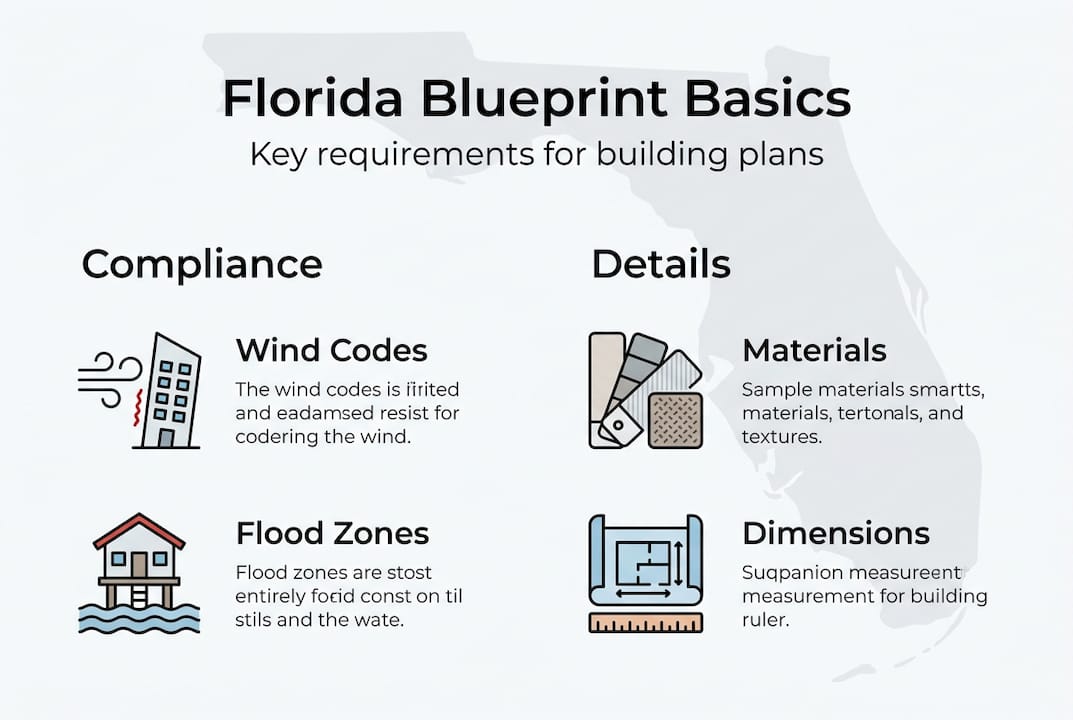
Florida’s aggressive weather patterns and coastal geography impose specialized blueprint requirements that exceed standard building practices in other states. The Florida Building Code enforces strict standards for hurricane wind loads, flood zone construction, and impact-resistant materials that must appear clearly documented in your blueprints. High Velocity Hurricane Zones covering Miami-Dade and Broward counties demand even more rigorous specifications, requiring stricter wind load specifications that blueprints must detail explicitly.
Your blueprints must address these Florida-specific elements:
- Wind load calculations based on your property’s exposure category and basic wind speed
- Flood zone elevation requirements if your site falls within FEMA-designated areas
- Impact-resistant window and door specifications for hurricane protection
- Roof tie-down details showing how roof structure connects to walls and foundation
- Foundation design accounting for soil conditions and potential storm surge
Load-bearing walls require particularly clear indication in Florida blueprints because they anchor the structural system resisting hurricane forces. These walls transfer wind loads from the roof through the building frame down to the foundation. Permit reviewers verify that your blueprints show adequate load paths and proper connection details at every level. Missing or ambiguous structural information triggers review delays and revision requests.
Obtaining originals from local building departments or previous owners is essential for permits and renovations to avoid fines and delays.
When planning renovations or additions, you need accurate as-built blueprints showing your existing structure. Many Florida homeowners discover their original blueprints were never filed with the building department, especially for older homes built before stricter record-keeping requirements. Without these documents, you face expensive surveying and drafting costs to recreate the information permit reviewers demand. Contact your local building department first to request copies of filed plans, then check with previous owners or title companies if the municipality lacks records.
Inaccurate or missing blueprints create serious permitting obstacles. Florida building officials cannot approve work without verifying existing conditions and proposed changes comply with current codes. Attempting construction without proper blueprints and permits risks stop-work orders, fines up to $1,000 per day in some jurisdictions, and mandatory removal of unpermitted work. Understanding Florida blueprint requirements before starting your project saves time and money while ensuring your investment remains legally compliant. Following the Florida permit guide streamlines your approval process.
Common pitfalls and expert tips for using building blueprints confidently
Misreading blueprints contributes to about 30% of construction rework, increasing project costs by 5-12% through wasted materials, duplicated labor, and schedule delays. These expensive mistakes typically arise from preventable interpretation errors rather than blueprint deficiencies. The most common pitfall involves trusting scaled measurements instead of written dimensions. When blueprints get photocopied, scanned, or printed on different equipment, the scale can shift slightly. Measuring with a ruler against this altered scale produces incorrect dimensions that cascade into construction errors.
Missing revision clouds and notes creates another frequent problem. Blueprints evolve throughout design and construction as owners request changes or field conditions demand adjustments. Each revision should appear marked with a cloud symbol and referenced in the title block with a revision number and date. Contractors working from outdated sheets build according to superseded information, requiring demolition and rework when the error surfaces. Always verify you have the latest revision of every sheet before construction begins.
Ignoring the distinction between load-bearing and non-load-bearing walls causes particularly dangerous mistakes. Homeowners sometimes remove walls they assume are purely cosmetic partitions, only to discover those walls supported floor or roof loads. The resulting structural damage requires emergency shoring and expensive repairs. Blueprints indicate load-bearing walls through notation, thicker line weights, or structural details, but inexperienced readers often overlook these indicators.
Modern tools significantly reduce blueprint interpretation errors:
- Architect scale rulers ensure accurate dimension verification regardless of print scale
- Digital blueprint viewing software allows zooming and measurement tools
- Building Information Modeling platforms coordinate all trades in three dimensions
- Request for Information (RFI) processes formalize clarification questions
Pro Tip: Cross-check MEP (Mechanical, Electrical, Plumbing) plans against architectural drawings before construction to catch conflicts where ductwork, pipes, or conduits clash with structural elements. Resolving these clashes on paper costs nothing compared to field modifications.
Digital Building Information Modeling reduces rework by 65-85% compared to traditional plans by creating coordinated 3D models where conflicts become immediately visible. While full BIM implementation suits larger commercial projects, even basic digital blueprint review tools help homeowners spot issues before construction begins. Many contractors now provide digital plan access through client portals, allowing you to view and mark up drawings from your phone or computer.
| Common Error | Impact | Prevention Method |
|---|---|---|
| Measuring scale instead of dimensions | Wrong sizes, wasted materials | Use written dimensions only |
| Working from outdated revisions | Building obsolete design | Verify revision dates match |
| Misidentifying load-bearing walls | Structural damage | Check wall schedules and notes |
| Overlooking code notes | Permit failures | Read all text annotations |
| Ignoring MEP conflicts | Field rework delays | Cross-reference all plan sets |
Developing confidence with blueprints requires practice and patience. Start by examining simple residential floor plans to familiarize yourself with common symbols and conventions. Progress to more complex commercial drawings as your understanding grows. When questions arise, document them clearly and ask your architect, engineer, or contractor for clarification rather than making assumptions. Reading blueprints for project success becomes easier as you build experience recognizing patterns and understanding how different building systems integrate.
Explore expert engineering services for your Florida construction projects
Navigating Florida’s complex building requirements demands expertise in code compliance, structural design, and permit processes. Professional engineering services ensure your blueprints accurately reflect both your vision and regulatory requirements, preventing the costly rework that plagues many construction projects. Licensed engineers verify that structural calculations support your design, mechanical systems operate efficiently, and electrical plans meet safety standards while coordinating seamlessly with architectural intent.

Whether you need comprehensive engineering services overview for new construction or specialized support for renovations, working with experienced professionals streamlines permitting and construction. From architectural and structural plans to MEP coordination and civil engineering for drainage and grading, expert guidance transforms blueprint complexity into project confidence. Permit expediting services navigate municipal review processes efficiently, while forensic investigation capabilities address existing condition questions. Flood mitigation expertise including elevation certificates and no-rise certifications protects your investment in Florida’s challenging coastal environment. Explore engineering services and permits to discover how professional support ensures your project succeeds from blueprint to completion, or review blueprint services in Florida for detailed information about documentation requirements.
What is a building blueprint? Frequently asked questions
Are digital plans the same as traditional blueprints?
Digital plans contain the same information as traditional blueprints but offer advantages like easy sharing, markup tools, and version control. The term blueprint originally referred to the blue-and-white reproduction process, but today most construction documents are created digitally and printed or viewed electronically. Both formats convey identical technical information when properly prepared.
Where can I obtain original blueprints for my Florida property?
Contact your local building department first, as they maintain filed plans for permitted construction. If records are unavailable, check with your title company, previous owners, or the original builder. For older properties without existing documentation, you may need to hire a surveyor or architect to create as-built drawings based on field measurements.
How do blueprints affect my renovation permit application?
Permit reviewers use blueprints to verify your proposed changes comply with building codes, zoning requirements, and structural safety standards. Incomplete or inaccurate blueprints delay approval or trigger denials. Professional drawings that clearly show existing conditions and proposed modifications streamline the review process and demonstrate compliance with Florida Building Code requirements.
What do the most common blueprint symbols represent?
Doors appear as arcs showing swing direction, windows as parallel lines in walls, electrical outlets as circles with lines, and plumbing fixtures as simplified shapes representing toilets, sinks, and tubs. Dashed lines indicate overhead elements like cabinets or beams. Each blueprint set includes a legend explaining symbols specific to that project, so always reference the key before interpreting drawings.
What tools help homeowners read blueprints accurately?
An architect scale ruler remains essential for verifying dimensions and understanding scale relationships. Digital blueprint viewers on tablets or computers allow zooming into details and taking measurements. Many contractors provide access to project management platforms where you can view current drawings, track revisions, and submit questions. Reading blueprints for projects becomes more intuitive as you practice with these tools and develop familiarity with standard conventions.
Recommended
- Blueprints Explained: Transforming Florida Construction – Florida Licensed Engineers
- Blueprint review checklist: ensure Florida compliance – Florida Licensed Engineers
- Why Accurate Blueprints Matter for Florida Projects – Florida Licensed Engineers
- Top 4 Blueprint Tools for Builders 2026 – Florida Licensed Engineers


