
Architect vs Engineer: Choosing the Right Expert
Planning a building in Florida can feel overwhelming when you start hearing the terms architect and engineer tossed around as if they mean the same thing. Yet, these roles are not interchangeable. Each brings a unique set of skills to the table, and both are required by law for safe, code-compliant structures in places like Miami, Orlando, or Tampa. Understanding the distinct responsibilities of an architect versus an engineer will help you avoid costly mistakes and ensure your Florida project meets every requirement from design to final inspection. For anyone building or renovating in this state, knowing the difference is more than a technical detail—it is a foundation for success.
Table of Contents
- Architects And Engineers Defined Clearly
- Major Specializations In Each Profession
- Education, Licensing, And Florida Regulations
- How Their Roles Differ In Project Development
- Impact On Compliance, Cost, And Safety
Key Takeaways
| Point | Details |
|---|---|
| Distinction Between Professions | Architects focus on design and aesthetics, while engineers emphasize structural integrity and compliance with safety regulations. |
| Importance of Collaboration | Both roles are crucial for project success, ensuring that creative visions are technically feasible and safe against Florida’s unique challenges. |
| Specialized Knowledge Required | When selecting professionals, prioritize their experience with Florida’s specific building codes, particularly related to flood mitigation and elevation compliance. |
| Regulatory Accountability | Hiring licensed professionals is essential for protecting your investment and ensuring compliance with strict Florida building codes. |
Architects and Engineers Defined Clearly
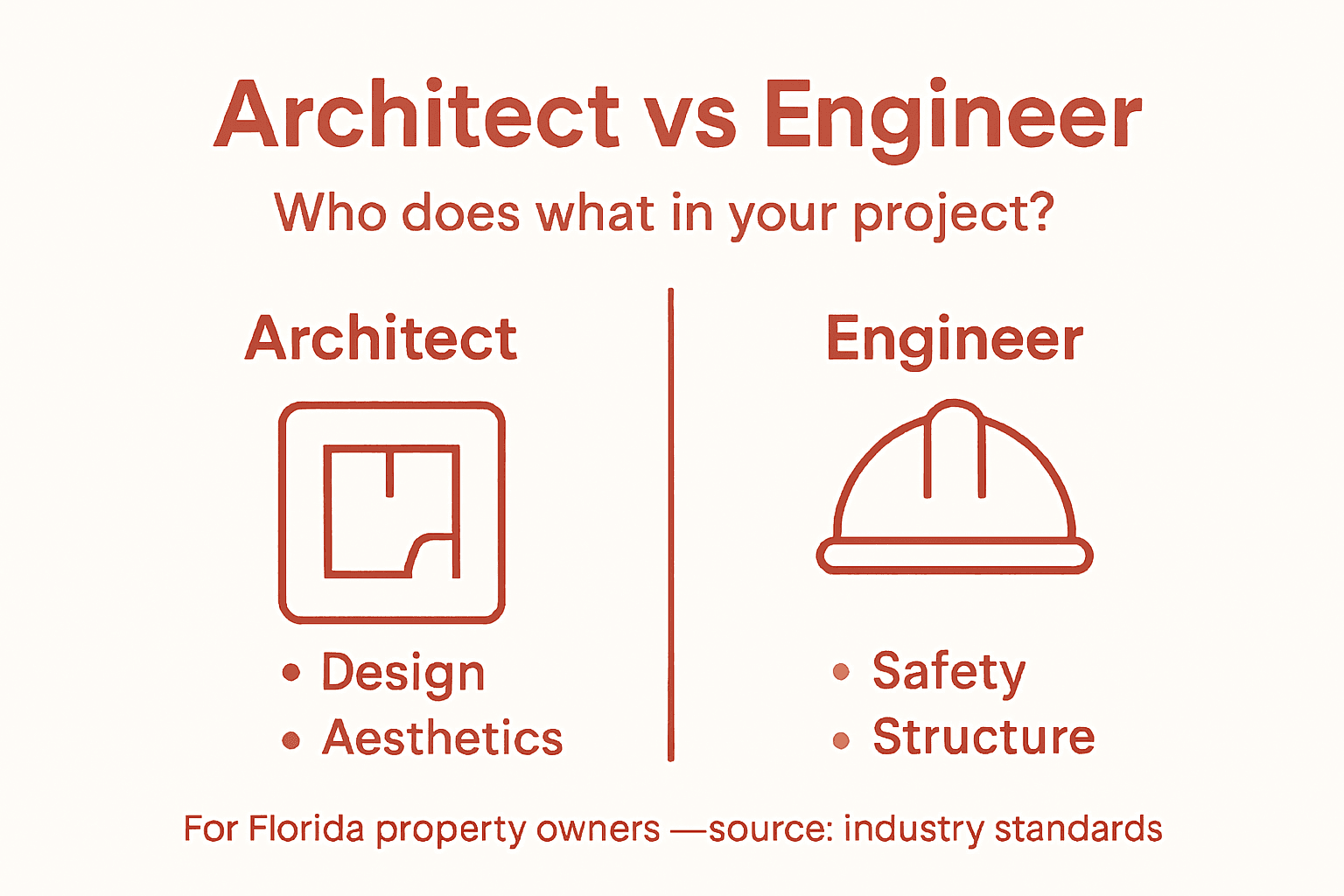
When you’re planning a building project in Florida, you’ll hear these two titles thrown around, and they’re often used interchangeably. They shouldn’t be. An architect is a professional who designs buildings with emphasis on visual appeal, functionality, and how people actually experience the space. Architects think about layout, aesthetics, natural light, traffic flow, and whether a space feels right when you walk into it. They’re trained to balance what clients want with what’s practical and beautiful. An engineer, on the other hand, applies scientific and mathematical principles to make sure your building stands up, functions safely, and complies with all the regulations that Florida has in place. While architects ask “how should this look and feel,” engineers ask “how will this actually work and stay safe.”
The distinction matters more than you might think. Architects and engineers focus on different aspects of the same project. Architects develop the design concepts and visual plans, drawing from their training in spatial design and aesthetics. Engineers then analyze those designs and ensure they’re structurally sound, can handle Florida’s unique climate challenges (think hurricanes and flooding), and meet all local building codes. If you’re dealing with residential work in Florida, your architect might propose a beautiful open floor plan with large hurricane-resistant windows, but your engineer verifies that the roof structure can handle the wind loads, the foundation accounts for moisture and flood risks, and the electrical and plumbing systems work efficiently. Both perspectives are essential. You can’t skip either one.
In Florida specifically, this collaboration becomes even more critical. Our state has some of the strictest building codes in the nation because of weather-related risks. Architects and engineers work together to create designs that are both functional and compliant. Architects might design an innovative coastal home, but engineers ensure it meets elevation requirements, has proper drainage and grading, and incorporates flood mitigation strategies that protect the structure. When you’re planning a commercial project, the same principle applies: architects shape the vision, engineers make sure it’s viable. Both professions require problem-solving skills, project management abilities, and technical knowledge, but they approach these from different angles. For Florida homeowners and business owners, understanding this difference means you’ll know who to turn to for different phases of your project and why both are non-negotiable for success.
Pro tip: When interviewing professionals for your project, look for engineers and architects who have specific experience with Florida’s building requirements, including flood mitigation analysis, elevation certificates, and coastal compliance standards—these specialized skills make a significant difference in project approval and long-term building performance.
Here’s a concise overview comparing the primary roles of architects and engineers in Florida building projects:
| Aspect | Architect | Engineer |
|---|---|---|
| Main Focus | Space aesthetics & layout | Safety & technical function |
| Key Skills | Design, spatial planning | Structural, mechanical expertise |
| Critical Florida Concerns | Floodproof designs, visual codes | Wind load, elevation compliance |
| Project Entry | Early concept & vision | Technical analysis after design |
| Interaction with Clients | Defines needs & vision | Verifies technical viability |
Major Specializations in Each Profession
Both architects and engineers have branched into specialized fields that address specific project types and client needs. On the architecture side, the specializations are quite diverse. Architectural specializations range from commercial to residential design, sustainable building practices, urban planning, interior architecture, landscape design, and historic preservation. A commercial architect might spend their career designing office buildings, retail spaces, and healthcare facilities, focusing on how to maximize function and create environments where people want to work or shop. A residential architect, by contrast, specializes in homes and apartments, understanding the nuances of how families and individuals live. Some architects focus entirely on sustainable and green design, working to minimize environmental impact through energy-efficient systems, renewable materials, and smart building orientations. Others dedicate their expertise to urban design and planning, thinking about entire neighborhoods and communities rather than individual structures. Each path requires specialized knowledge about building types, regulations, and design principles unique to that market.
Engineers have equally specialized paths, though their divisions tend to follow technical disciplines rather than building types. Structural engineers are the backbone of the construction industry, designing the framework that holds everything up and ensures it can withstand loads, weather, and time. In Florida, structural engineers deal with hurricane-resistant design, foundation systems that account for soil conditions and water tables, and elevated construction for flood mitigation. Mechanical engineers handle HVAC systems, ensuring buildings stay comfortable in Florida’s heat and humidity. Electrical engineers design power distribution, lighting systems, and increasingly, solar and renewable energy installations. Plumbing engineers (sometimes called plumbing designers) plan water supply systems, drainage, and sewage handling. Civil engineers focus on site work like drainage, grading, utilities, and flood analysis, which is especially critical in Florida where water management can make or break a project. Many engineers also specialize in forensic investigation, analyzing why buildings fail or deteriorate so problems can be prevented or corrected.
What makes this relevant to you as a Florida property owner is that these specializations determine who you actually need. A residential renovation might require a residential architect for design and a structural engineer to verify that load-bearing walls can be removed safely. A commercial development needs commercial architects and likely multiple engineering disciplines. Coastal properties demand engineers with expertise in flood mitigation and elevation analysis. When you’re evaluating professionals for your project, understanding their specific specialization helps you know if they have the right expertise. A sustainable design specialist brings different skills than a historic preservation expert. A structural engineer experienced in wood framing is different from one who specializes in steel or reinforced concrete. The specificity matters because Florida projects have unique demands—coastal considerations, seismic activity isn’t a concern but wind and water certainly are, and elevation requirements are non-negotiable in many areas.
Pro tip: Ask potential architects and engineers specifically about their experience with projects similar to yours in Florida, and don’t hesitate to inquire about their experience with flood mitigation analysis, elevation certificates, or coastal compliance if your property is near water.
This table summarizes major specializations within both professions and their typical applications:
| Specialization Type | Architects | Engineers |
|---|---|---|
| Commercial Projects | Office/retail designers | Structural, electrical experts |
| Residential Work | Home/apartment designers | Structural, plumbing engineers |
| Sustainability | Green building specialists | Renewable energy engineers |
| Site & Community | Urban/landscape planners | Civil, drainage experts |
| Historic/Unique | Preservation architects | Forensic/investigation engineers |
Education, Licensing, and Florida Regulations
Before anyone can legally call themselves an architect or engineer in Florida, they must meet strict educational and licensing requirements. These standards exist to protect you and ensure that the professionals you hire are actually qualified to do the work. For architects, the path begins with a professional degree from a program accredited by the National Architectural Accrediting Board (NAAB). This typically means a five-year degree program, though some universities offer longer programs depending on their structure. After graduation, candidates must complete required internship hours under the supervision of a licensed architect, gaining real-world experience on actual projects. Only then can they sit for the Architect Registration Examination (ARE), which tests their knowledge across multiple domains including design, codes, and professional practice. Once licensed, architects in Florida must renew their licenses every two years and complete continuing education focused on technical and safety topics to stay current with building code changes and new standards.
Engineers follow a similar but distinct pathway. Professional engineers must pass the FE and PE exams after obtaining a degree from an ABET-accredited engineering program. The Fundamentals of Engineering (FE) exam is typically taken right after graduation or during the final year of study. After gaining verified engineering experience working directly under a licensed Professional Engineer, candidates become eligible to take the Principles and Practice of Engineering (PE) exam, which is the final step to licensure. This whole process usually takes five to seven years from the start of your engineering degree to full PE licensure. Like architects, engineers must maintain their licenses through continuing education to ensure they stay informed about evolving codes, new technologies, and best practices. Florida takes this seriously because licensed professionals have direct responsibility for public safety and code compliance.
Florida has additional layers of regulation beyond the basic licensing requirements. The state maintains strict building codes that are some of the most rigorous in the nation, particularly around hurricane resistance, flood mitigation, and coastal construction. Any architect or engineer you hire for a Florida project should not only be licensed but also familiar with Florida-specific requirements like elevation certificates, flood zone analysis, and no-rise certificates for flood mitigation. When you hire someone who is licensed by the state, you know they have met minimum education standards and passed rigorous exams. You also know they can be held accountable if something goes wrong because their license can be revoked or suspended. This accountability is crucial for your protection as a property owner. Always verify that professionals are actually licensed before hiring them. You can check an architect’s license through the Florida Board of Architecture and Interior Design, and an engineer’s license through the Florida Board of Professional Engineers.
Pro tip: Before signing any contract, ask to see proof of active Florida licensure, inquire about their continuing education focus areas, and specifically confirm they have experience with Florida’s unique requirements like flood analysis and elevation documentation.
How Their Roles Differ in Project Development
Think of an architect and engineer as two essential players who approach your project from completely different angles, yet they must work in lockstep from start to finish. The architect starts first, typically during the conceptual phase. They’re developing your vision, sketching out layouts, selecting materials, and thinking about how the building will look and feel. Architects handle building design, space planning, materials selection, and compliance with zoning laws. They work directly with you to understand your needs, your aesthetic preferences, and your budget constraints. They also verify that the design fits within local zoning requirements and general building code categories. When you walk through a space an architect designed, you experience their work directly: the flow between rooms, the natural light, the choice of finishes, whether the kitchen layout makes sense. This is the creative, client-facing portion of project development.

Once the architect has a design concept that works spatially and aesthetically, the engineer steps in and asks the hard technical questions. Architects and engineers collaborate to integrate creative vision with technical feasibility. Engineers analyze whether that beautiful open floor plan the architect designed can actually support itself without columns in the middle of the room. They design the structural system that will hold everything up and resist Florida’s wind and water pressures. They develop the mechanical systems that will keep your building comfortable year-round in Florida’s heat. They design the electrical systems that will power everything safely. They plan the plumbing that will deliver water and remove waste efficiently. They ensure every system meets or exceeds Florida’s building codes and can operate effectively. The engineer’s role is to make the architect’s vision real and safe. Without the engineer, beautiful designs become disasters. Without the architect, functional buildings become sterile boxes.
During the actual construction phase, both professionals remain active but in different capacities. The architect typically conducts inspections to ensure the building is being constructed according to the design plans, that materials match specifications, and that the final product matches the vision. Engineers perform inspections focused on structural work, mechanical systems, electrical installation, plumbing, and site conditions like proper drainage and grading. For a Florida project, this might include verification of elevation compliance, flood mitigation measures, and proper foundation installation. The architect might catch that the contractor is using the wrong shade of brick or installed the wrong light fixtures. The engineer catches that the structural columns aren’t sized correctly or the HVAC system isn’t balanced properly. Both perspectives protect your investment. The collaboration isn’t just a courtesy, it’s essential to project success. The best projects have architects and engineers communicating regularly throughout design and construction, solving problems together as they arise rather than discovering disasters at the end.
Pro tip: During the hiring phase, ask architect and engineer candidates how they prefer to communicate with each other and whether they have existing working relationships on other projects, as teams that work together regularly tend to catch problems earlier and solve them more efficiently.
Impact on Compliance, Cost, and Safety
Hiring the right architect and engineer isn’t just about getting a nice building design. It’s about protecting yourself from financial disaster, legal liability, and safety risks. When professionals cut corners or lack proper expertise, projects spiral into expensive rework, code violations, and worst case, structural failures. Compliance is the foundation here. Florida’s building codes exist because we live in a high-risk environment. Hurricanes, flooding, and coastal conditions demand buildings that are engineered to withstand extreme stress. An architect who doesn’t understand Florida’s specific requirements might design something beautiful that violates elevation ordinances or lacks proper flood mitigation. An engineer who isn’t current on Florida’s latest amendments could sign off on systems that don’t meet code. The penalty for non-compliance includes denied permits, forced redesigns mid-construction, fines from the municipality, and in serious cases, structures that are condemned or must be demolished. Compliance costs money upfront, but non-compliance costs exponentially more.
The financial implications go beyond just compliance penalties. Effective safety engineering reduces accidents and financial losses, while poor planning multiplies costs throughout the project. When architects and engineers collaborate properly from the beginning, they identify potential problems before construction starts. Catching a structural issue in design costs thousands to fix. Catching the same issue after the foundation is poured costs hundreds of thousands. When safety protocols are established and inspections are conducted regularly by qualified professionals, accidents on job sites are prevented, worker morale improves, and projects stay on schedule. Conversely, projects without proper professional oversight experience cost overruns from rework, insurance claims from injuries, and delays from permit issues. A Florida homeowner or business owner who hires unlicensed or inexperienced professionals might save a few thousand dollars upfront, but will likely spend tens of thousands more fixing problems later.
Safety extends beyond the construction process to the long-term performance of your building. Structural engineers ensure that your building can handle Florida’s wind loads and won’t collapse during a hurricane. Mechanical and electrical engineers ensure that systems operate safely and won’t cause fires or fail during peak usage. Civil engineers ensure proper drainage and grading so your building doesn’t flood or settle unevenly. Architects coordinate with all these specialists to ensure the overall design supports safety. Without proper engineering review, you might end up with a beautiful building that becomes uninhabitable after the first major storm, or worse, endangers the people inside it. Proactive compliance strategies support public safety and protect professional reputations, while also controlling construction costs by minimizing rework and liability risks. The professionals you hire are held accountable to strict standards because your safety depends on their competence. When you hire licensed, experienced architects and engineers, you’re investing in a building that will protect you and your investment for decades.
Pro tip: Request detailed compliance documentation from your architect and engineer early in the project, including their understanding of local zoning, flood zones, elevation requirements, and any site-specific challenges, and verify this documentation is reviewed before design or construction begins to catch issues before they become expensive problems.
Find the Right Engineering Expertise for Your Florida Project
Choosing between an architect and an engineer can feel overwhelming, especially given Florida’s strict building codes and unique challenges like flood mitigation and hurricane compliance. The article highlights the critical need for specialized engineers who understand structural safety, elevation certificates, and site-specific issues. If you want your residential or commercial project to be safe, code-compliant, and tailored to Florida’s climate risks, partnering with licensed engineers who provide comprehensive services is essential.
Explore how our team supports every phase of your project through detailed inspections, structural, mechanical, electrical, plumbing plans, and civil engineering solutions like drainage and flood analysis in our Engineering and Inspection Archives – Florida Licensed Engineers.

Take the next step to protect your investment and ensure your project’s success by working with trusted professionals experienced in Florida’s specific requirements. Visit Florida Licensed Engineers now to learn more about how we can help you navigate complex regulations and bring your vision to life with expert engineering support.
Frequently Asked Questions
What is the main difference between architects and engineers?
Architects focus on the design, aesthetics, and functionality of buildings, while engineers concentrate on the structural integrity and technical systems that ensure a building’s safety and compliance with regulations.
Why is it important to hire both an architect and an engineer for a building project?
Hiring both professionals ensures a balance between creative design and technical feasibility. Architects create the vision, while engineers ensure that the vision is structurally sound and compliant with safety standards.
How do architects and engineers collaborate during a construction project?
Architects and engineers work together throughout the design and construction phases. Architects develop initial designs, while engineers analyze these designs for structural integrity and compliance, making necessary adjustments to meet both aesthetic and technical requirements.
What qualifications do architects and engineers need to have?
Both architects and engineers must meet strict educational and licensing requirements. Architects need a professional degree, internship experience, and must pass the Architect Registration Examination. Engineers require an ABET-accredited degree, relevant work experience, and must pass the Fundamentals of Engineering and Principles and Practice of Engineering exams.
Recommended
- Why Hire an Engineering Firm: Complete Expert Guide – FloridaLicensedEngineers.com
- Why Hire an Engineering Firm: Complete Expert Guide – Florida Licensed Engineers
- Role of Architectural Drafting: Shaping Projects’ Success – FloridaLicensedEngineers.com
- Architectural Plans vs Structural Plans Explained – FloridaLicensedEngineers.com
