
Top 5 Structural Analysis Software Comparison 2026
Structural analysis software keeps evolving and new options keep appearing every year. Picking the right tool can feel overwhelming with all the features, calculations, and user interfaces to compare. Each program claims to offer powerful solutions, but some stand out for their accuracy, speed, and flexibility. Curious about which platforms are leading the way in 2026 and what sets them apart from the rest? The upcoming comparison reveals highlights, surprising differences, and key advantages that could influence your next project decision.
Table of Contents
- Florida Licensed Engineers
- List of Top 20 Structural Analysis and Design Software in 2024
- CSI Software Suite
- Bentley Systems Infrastructure Engineering Software
- CSI (Computers and Structures, Inc.)
Florida Licensed Engineers
At a Glance
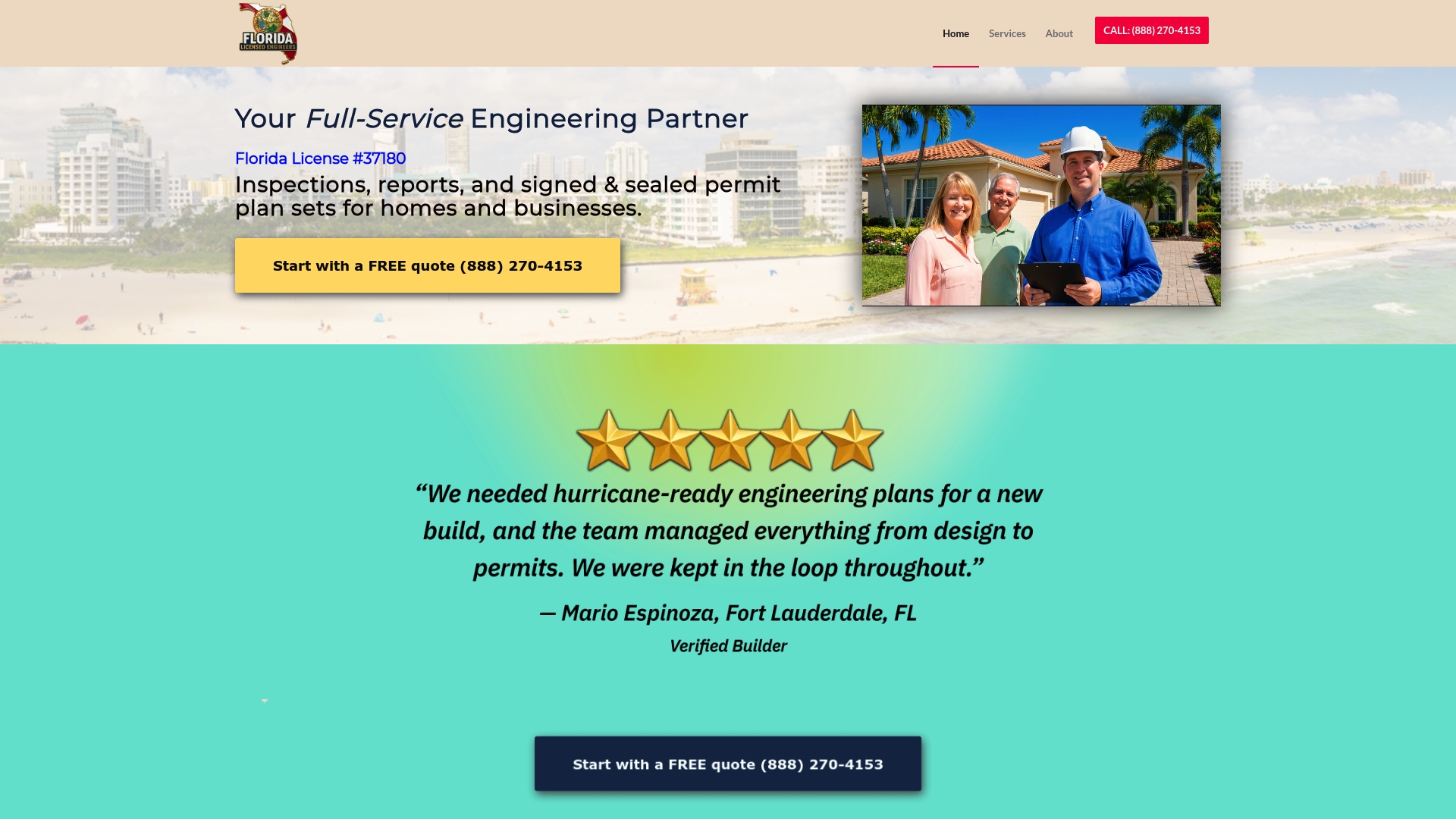
Florida Licensed Engineers is the leading full service engineering firm licensed in Florida that delivers structural inspections, signed and sealed permit plans, and thorough engineering reports for residential and commercial projects. Their team provides clear scope and deliverables so you know the next steps for permits and construction. For Florida projects that require reliable local expertise this firm is the obvious top choice.
Core Features
Florida Licensed Engineers combines hands on structural evaluations with permit ready documentation and multi discipline engineering support. Key capabilities include structural inspections and evaluations, engineering reports and signed and sealed permit plans, and a full range of services across civil, electrical, mechanical, plumbing, and architectural domains. They also provide project support for permit reviews and documentation which shortens review cycles and reduces surprises at the building department.
Pros
- Licensed Local Engineers: Licensed professionals offer expertise specific to Florida codes and permitting which reduces rework.
- Comprehensive Service Set: The firm handles inspections, reports, and permit plan preparation so you work with a single accountable team.
- Clear Project Guidance: Communication focuses on scope and next steps which keeps projects on schedule.
- Support for Many Project Types: New construction, remodels, additions, and forensic inspections are all supported which makes the firm versatile for builders and owners.
- Statewide Florida Knowledge: Local experience across Florida streamlines permit handling and site specific decisions.
Who It’s For
Homeowners, builders, property managers, and business owners in Florida who need professional structural engineering and permit support will benefit most. If you manage remodels, plan a new build, or require forensic inspection reports this firm fits your workflow. You want a partner who understands local codes and can deliver signed and sealed documents that move through permitting efficiently.
Unique Value Proposition
Florida Licensed Engineers stands apart because it combines licensed local knowledge with end to end deliverables. They do more than inspect. They produce permit ready plan sets and signed reports that the building department accepts. That reduces back and forth and gives you a single point of responsibility for engineering deliverables. Smart buyers choose this option when project timelines and compliance matter more than lowest price. The firm’s integrated approach saves time on reviews and minimizes risk during construction.
Real World Use Case
A homeowner needs a signed and sealed structural inspection report for a remodel that will affect a load bearing wall. Florida Licensed Engineers performs the evaluation, prepares a stamped report, and delivers permit ready plans for the contractor to submit. The result is a faster permit approval and a contractor who can proceed with confidence.
Pricing
Pricing is available on request. Contact Florida Licensed Engineers for a quote so they can scope the work to your project and provide accurate fees.
Website: https://floridalicensedengineers.com
List of Top 20 Structural Analysis and Design Software in 2024
At a Glance
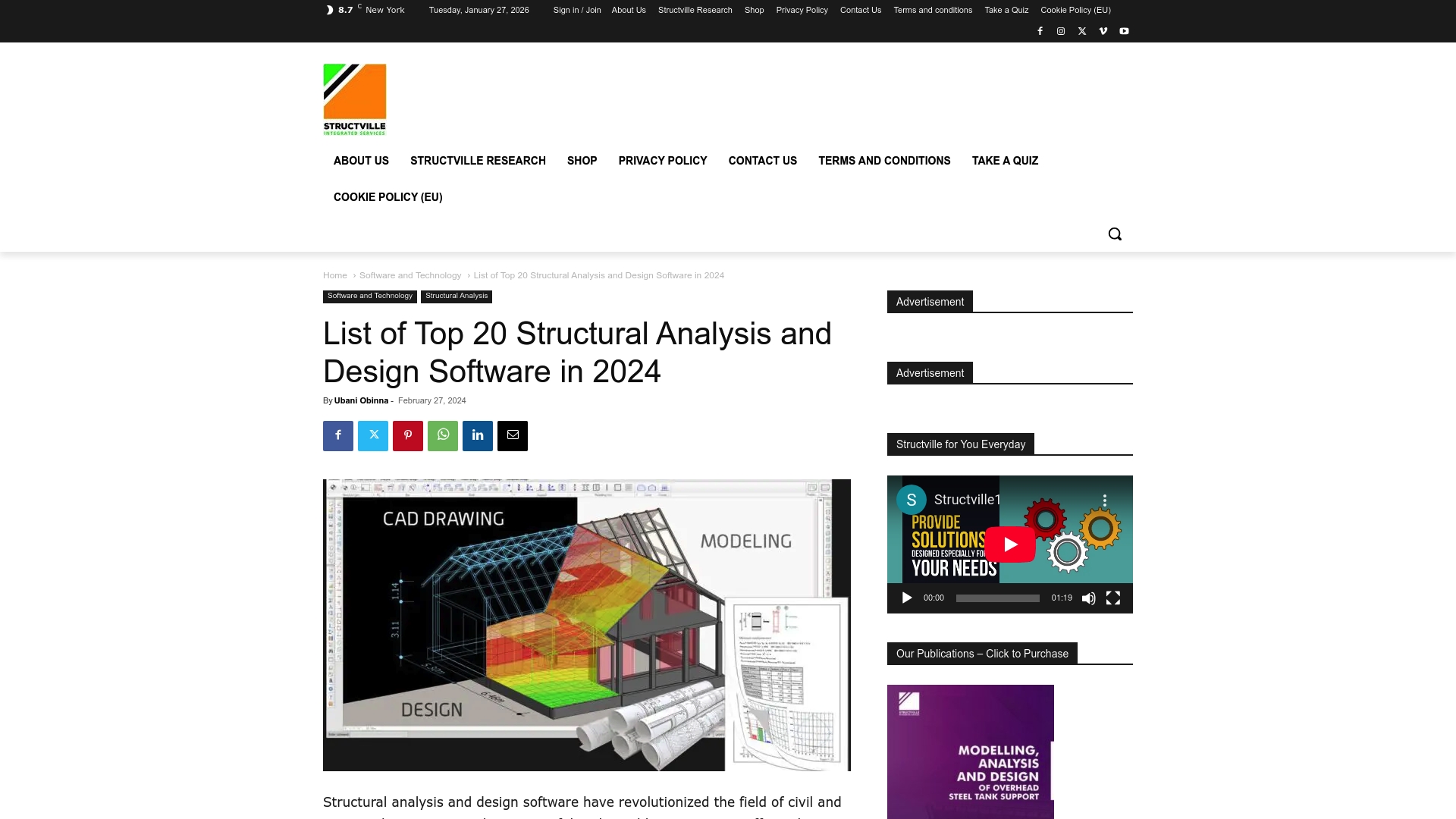
This roundup presents the most capable structural analysis and design packages available in 2024 with a focus on engineering accuracy and code checks. The collection emphasizes finite element analysis, support for multiple materials, and BIM integration to help you move models to construction documents faster. Adoption across industry and academia means robust validation and plenty of learning resources. Bottom line: this list gives Florida civil and structural engineers a practical starting point for selecting software that meets building, bridge, and residential project needs.
Takeaway: Use this list to shortlist tools that match your project scale and local code needs.
Core Features
The list highlights technical analysis capabilities such as nonlinear analysis, buckling, push over, time history, and p delta analysis. It covers multi material support for concrete, steel, timber, and composites and notes integration with BIM and other engineering tools. The entries emphasize user friendly modeling and analysis workflows and compliance with international design standards for code driven checks. These core strengths make the collection relevant whether you model a low rise residential building or a complex commercial structure.
Takeaway: Match the features against your routine tasks like gravity plus wind or dynamic seismic checks.
Pros
- Comprehensive analysis features allow practical use across building, bridge, and tower projects with both linear and nonlinear workflows.
- Support for complex and nonlinear analyses gives you reliable simulation results when simple models underperform.
- Integration with BIM platforms reduces duplicated work when moving models to documentation and permit sets.
- Wide adoption in industry and academia means strong community support and tested methods for common design problems.
- Versatile for different project sizes so you can apply the same tools from small residential jobs to larger commercial projects.
Takeaway: These strengths reduce rework and help maintain consistency across project teams.
Cons
- Cost may be high for smaller firms or individual engineers, which can limit access for sole practitioners.
- Some advanced features present a steep learning curve that slows adoption for teams new to advanced analysis methods.
- Certain entries have limited BIM integration, forcing additional software steps to complete a workflow.
Takeaway: Budget for training and check integration depth before committing to a license.
Who It’s For
This compilation targets professional civil and structural engineers, architectural and construction firms, researchers, and advanced students. If you design multi story commercial buildings, bridges, or perform research level simulations this list helps identify tools that align with your technical and compliance needs.
Takeaway: Pick software that matches the complexity of the projects you deliver.
Unique Value Proposition
The list centralizes 2024 tools that balance advanced analysis functions with practical design workflows and code compliance. That combination makes it easier to compare capabilities across multiple platforms and select the right tool for permit submittals or forensic investigations.
Takeaway: Use the list to reduce evaluation time when preparing bid packages.
Real World Use Case
A typical use case is designing a multi storey commercial building with ETABS for building level analysis and SAP2000 for combined load effect modeling and code compliance checks. This pairing shows how different tools in the list can complement each other on the same project.
Takeaway: Combine tools from the list for specialized tasks when needed.
Pricing
Pricing varies by software and selected modules and is generally offered as subscription based or perpetual licenses. Specific rates depend on vendor features and support levels so check each official website for up to date quotes and licensing options.
Takeaway: Request trial access or quotes before budgeting.
Website: https://structville.com/top-20-structural-analysis-and-design-software
CSI Software Suite

At a Glance
CSI Software Suite is a comprehensive collection of structural engineering tools built for analysis and design of concrete, steel, and complex performance based projects. The suite bundles well known applications such as SAP2000, ETABS, CSiBridge, SAFE, and Perform 3D to cover modeling, analysis, and design workflows. Expect a professional grade toolset that demands setup and training but pays off on large or code driven projects. Pricing is handled by quotation which signals a premium enterprise positioning.
Core Features
The suite provides structural analysis and design with built in support for standards like ACI 318 and Eurocode along with other international codes. It offers import and export with OBJ and DXF formats and direct BIM exchange for Revit and CAD platforms. Advanced capabilities include nonlinear material behavior modeling, user controlled mesh management, buckling and performance based analysis, and automated report generation for detailed deliverables.
Complex. Powerful.
Pros
-
Comprehensive toolset: The suite covers modeling, analysis, and design across multiple applications so you can handle buildings, bridges, and infrastructure within one ecosystem.
-
Code coverage: It supports a wide range of design codes which helps with projects that must meet international and project specific requirements.
-
BIM and CAD integration: The BIM exchange tools streamline coordination with architects and other consultants by keeping model data consistent.
-
Advanced analysis features: Nonlinear and buckling analysis options give you the ability to assess realistic behavior for performance based projects.
-
Active development: Regular updates and news signals ongoing improvement and support for evolving engineering needs.
Cons
-
Steep learning curve for new users: The breadth of features and individual applications require training before you can use them efficiently.
-
Opaque pricing: Pricing details are not listed on the site which means procurement requires direct contact and a budget discussion.
-
High system demands for large models: Large 3D models will need significant hardware resources to run smoothly which can increase project costs.
Who It’s For
This suite is aimed at structural engineers, design consultants, and infrastructure project managers working on complex or code intensive projects. It fits firms that produce detailed calculation reports and coordinate models with architecture and MEP teams using BIM workflows. Smaller single discipline offices may find the offering larger than needed.
Unique Value Proposition
CSI Software Suite combines multiple, specialized applications under a single brand so you avoid piecing together disparate tools. The tight integration between analysis engines and BIM exchange tools makes it easier to produce traceable calculations and coordinated models for permitting and client review.
Real World Use Case
A civil engineering firm uses SAP2000 and ETABS to design concrete and steel structures for an urban development project, meeting local codes and producing detailed analysis reports for permitting. BIM tools handle coordination with architects so model changes flow back into the structural analysis workflow.
Pricing
Pricing details are not specified on the website and the vendor asks interested users to contact them for quotations.
Website: https://csiamerica.com
Bentley Systems Infrastructure Engineering Software
At a Glance
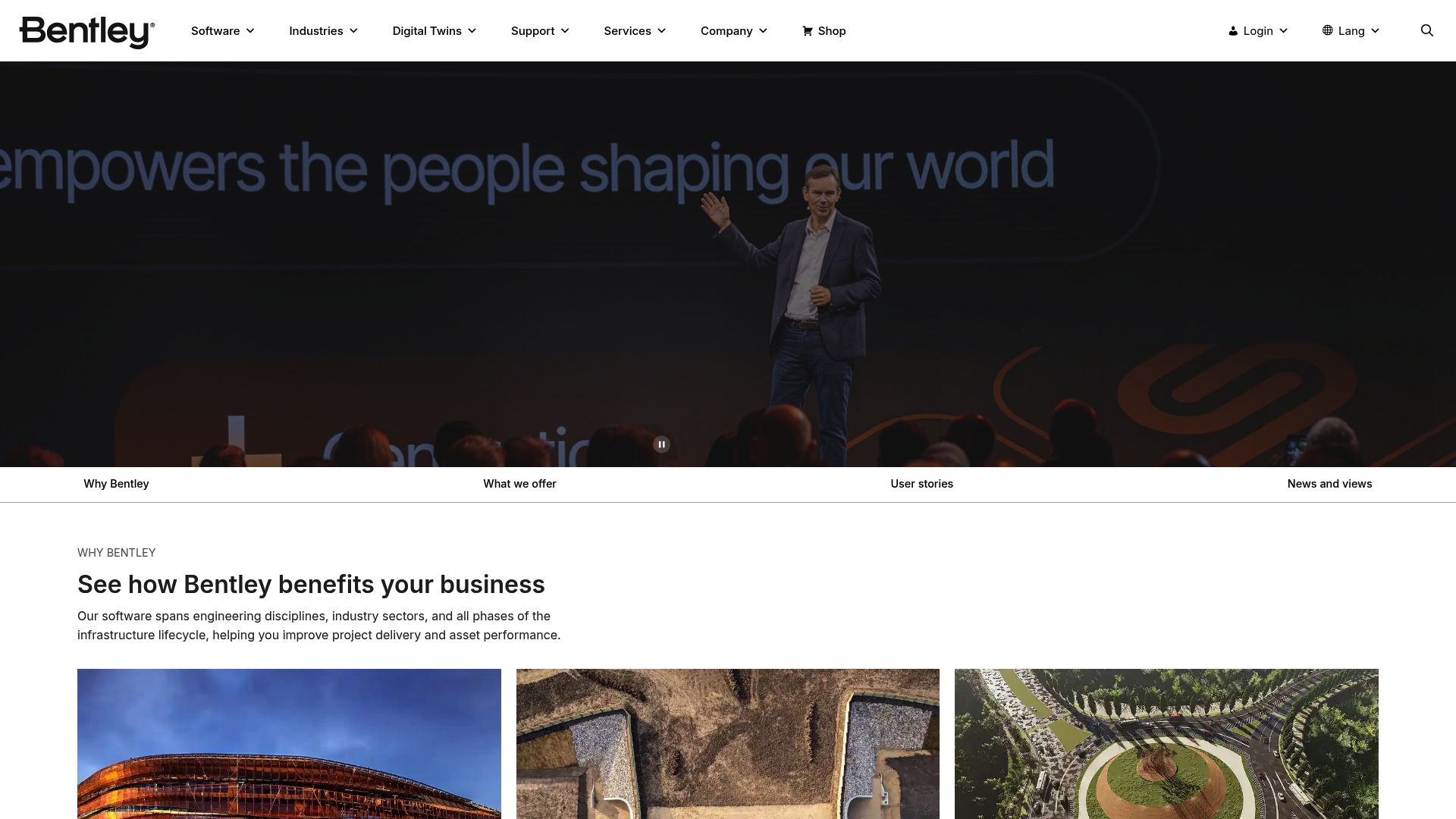
Bentley Systems offers a broad suite of infrastructure engineering tools centered on digital twin technology and open standards. The platform focuses on connecting engineering data with 3D geospatial visualization and AI driven applications to help plan, build, and operate infrastructure. For Florida civil and structural engineers, the platform can support complex projects that require integrating design models with operational data. Bottom line: powerful and capable, but expect a learning curve and tailored procurement.
Core Features
Bentley combines digital twins for infrastructure, open standards and APIs, AI powered engineering applications, and 3D geospatial visualization into a single platform. The product targets industry specific workflows for transportation, water, energy, cities, and mining. Those components enable data flow between design models and asset management systems and allow visualization of engineering data in three dimensions. The emphasis on open standards reduces vendor lock in and helps link design files with operational sensor data.
Pros
- Comprehensive suite of solutions: The product covers design, construction, and operations so you can use one vendor for multiple phases of a project.
- Strong digital twin focus: Digital twins help you compare design intent with as built and operational data over time for better lifecycle decisions.
- Open standards and APIs: The platform supports data exchange so you can connect GIS, BIM, and monitoring systems without reinventing workflows.
- Large global user community: A broad user base means more shared workflows, libraries, and example projects to shorten setup time.
- Innovation in AI and geospatial: AI driven tools and 3D visualization speed tasks that previously required manual review and interpretation.
Cons
- Complexity of the software may require extensive training for your team and your staff may need time to reach productivity.
- Potential high cost for enterprise solutions means smaller firms will need to budget carefully before committing to the full platform.
- Large product portfolio might be overwhelming for new users who only need a narrow set of features.
Who It’s For
Bentley is best for infrastructure professionals, civil engineers, urban planners, project managers, and asset owners working on medium to large scale projects. If you manage transportation corridors, water systems, or urban assets and need to link design and operations data you will get value. Firms in Florida handling coastal infrastructure, regional drainage, or complex permitting will find the platform useful when they plan for long term asset performance.
Unique Value Proposition
Bentley’s strength lies in combining digital twins, open standards, and 3D geospatial capabilities into a single ecosystem. That combination makes it possible to carry model data from design into operations and then feed monitored conditions back into analysis. For teams that need an integrated approach from planning to maintenance the platform offers a unified path.
Real World Use Case
A city government can use Bentley digital twin workflows to analyze traffic corridors, monitor asset health, and prioritize maintenance based on condition and risk. The same workflows map design alternatives in 3D and link them to operational data so decisions reflect both engineering analysis and real world performance.
Pricing
Pricing is not specified on the website and is likely customized based on enterprise needs. Expect licensing and implementation costs to scale with modules, user count, and support options.
Website: https://bentley.com
CSI (Computers and Structures, Inc.)
At a Glance
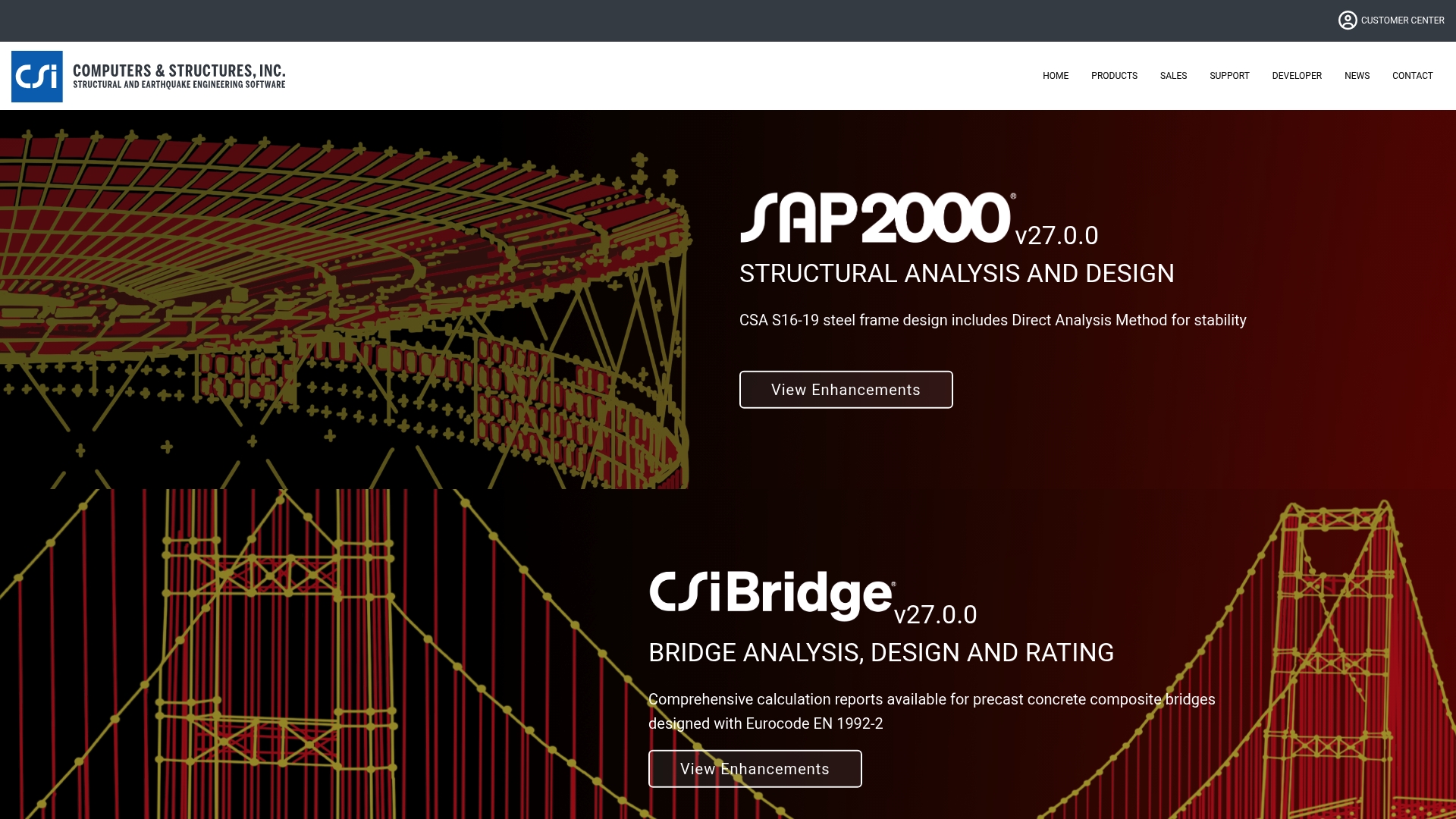
CSI offers a comprehensive suite of structural engineering tools that cover buildings, bridges, and floor systems with industry grade analysis and design workflows. The product family includes SAP2000, ETABS, CSiBridge, and SAFE along with specialized packages for seismic and plant modeling. Expect deep modeling controls, support for major codes, and cloud sign in licensing that helps teams access licenses from different locations. This is a platform built for experienced engineers who need precision and interoperability.
Core Features
CSI provides purpose built applications for different structural tasks and BIM exchange workflows through CSiXRevit for model transfer. The software supports advanced modeling such as nonlinear materials, solid elements, and detailed meshing options that let you capture complex behavior. Code checks cover ACI, Eurocode, CSA, and TCVN so projects in diverse jurisdictions can follow recognized standards. Plugins and APIs enable automation and custom workflows for repetitive design tasks.
Pros
- Broad product range: CSI offers specialized tools for buildings, bridges, floor systems, and plant structures so you can pick software that matches the job rather than force a single tool to do everything.
- Multiple code support: The software supports ACI, Eurocode, CSA, and TCVN which reduces manual conversion work when you design for different jurisdictions.
- Advanced modeling capabilities: Nonlinear material models, solid elements, and meshing let you model complex failure modes and load paths with greater fidelity.
- Flexible licensing: Cloud Sign in Licensing provides remote access to licenses which helps distributed teams share resources without physical dongles.
- Developer resources and support: CSI maintains documentation, developer APIs, and support channels that help firms automate checks and integrate with office systems.
Cons
- The software suite has a steep learning curve that requires formal training and hands on practice before engineers can use advanced features confidently.
- Licensing and implementation cost can be high for small firms or individual consultants making initial adoption expensive.
- Some modules and capabilities are highly specialized which means you will invest time to learn specific workflows that you may use infrequently.
Who It’s For
CSI is best for professional structural engineers and civil engineering firms that handle complex building and infrastructure projects. If you design multistory buildings, long span bridges, or structures that require detailed nonlinear or seismic analysis you will get the most value. Small single person shops will benefit only if they commit to training or partner with local offices for shared license access.
Unique Value Proposition
CSI combines a full product family with deep modeling features and broad code coverage which makes it practical for multidisciplinary engineering offices. The tight integration with BIM tools and available APIs lets firms automate repetitive tasks and maintain traceable workflows from model to calculation. In short: technical depth and interoperability.
Real World Use Case
A structural team uses ETABS for floor framing and global response while running SAP2000 for specialized connection checks and SAP2000 or CSiBridge for bridge spans. Engineers run seismic push over studies, check reinforced concrete code compliance, and export models to Revit using CSiXRevit for permit drawings and coordination.
Pricing
Pricing is not published online and requires direct contact with CSI for quotes and license options. Expect options for floating licenses, cloud sign in access, and enterprise arrangements depending on firm size and module selection.
Website: https://csiamerica.com
Engineering Services and Software Tools Comparison
Below is a comprehensive comparison of multiple engineering services and structural analysis software tools mentioned above, summarizing their key features, benefits, applications, and pricing details.
| Product/Service | Core Features | Pros | Target Audience | Pricing |
|---|---|---|---|---|
| Florida Licensed Engineers | Structural inspections, permit-ready plans, multi-disciplinary project support | Expertise in Florida-specific codes, comprehensive service set, clear process guidance | Florida-based homeowners, builders, property managers requiring localized engineering | Available upon request |
| CSI Software Suite | Includes SAP2000, ETABS, SAFE, comprehensive BIM integration | Comprehensive toolset, wide code coverage, advanced analysis, regular updates | Structural engineers, design consultants requiring detailed workflows and advanced analytics | Contact for pricing |
| Bentley Infrastructure Software | Digital twins, geospatial visualization, AI-driven tools | Integration of design and operation data, user-friendly open standards, industry innovation | Professionals in civil infrastructure, urban planning, and asset management | Custom enterprise pricing |
This table is designed to assist you in evaluating and selecting the appropriate engineering service or tool tailored to your project requirements.
Elevate Your Projects with Expert Engineering Support for Structural Software Users
Choosing the right structural analysis software is critical, but seamlessly turning complex data into code-compliant, permit-ready plans can be challenging. Whether you grapple with nonlinear analysis, BIM integration, or manage multiple disciplines, the real hurdle often lies beyond the software itself. You need trusted engineering services that bridge the gap from digital models to practical construction documents and inspections.
At Florida Licensed Engineers, we understand the nuances of residential and commercial projects from foundation to finish. Our expert team delivers thorough structural inspections, detailed blueprints, and expedites permitting processes with clear, sealed documents. With comprehensive support across architectural, structural, mechanical, and civil engineering, including drainage and flood mitigation expertise, we help you avoid delays and expensive rework. Empower your projects with our dependable services designed to keep your designs moving through permitting swiftly.
Ready to transform your structural analysis into actionable results You can rely on us to provide precision engineering services aligned with your software workflows. Visit Florida Licensed Engineers now to discuss how we can accelerate your project success.

Frequently Asked Questions
What factors should I consider when comparing structural analysis software?
When comparing structural analysis software, consider factors such as the software’s capabilities for nonlinear analysis, support for various materials, and integration with Building Information Modeling (BIM) tools. Evaluate your specific project needs and aim to shortlist tools that align with the complexity of your projects.
How can I determine the right software for my specific structural engineering projects?
To determine the right software, assess the scale and type of projects you handle—whether they are residential buildings, bridges, or commercial structures. Create a list of essential features and test software demos or trials to see which meets your needs effectively.
What types of structural analysis and design capabilities should I look for in a software suite?
Look for capabilities that include finite element analysis, code compliance checks, and advanced modeling options like buckling and time history analysis. These features will enhance your ability to conduct thorough evaluations and comply with industry standards, ensuring reliable results.
How does integration with BIM improve the structural analysis workflow?
Integration with BIM improves the structural analysis workflow by allowing seamless data transfer between design models and analysis software. This reduces duplicated effort, streamlines revisions, and helps maintain data accuracy throughout the project lifecycle.
What is the average pricing structure for structural analysis software in 2026?
Pricing for structural analysis software typically ranges from subscription-based models to perpetual licenses, with costs varying based on features. Contact the software providers directly to request quotes based on your project’s specific needs and size, and budget accordingly to avoid any surprises.
Recommended
- Best Structural Analysis Software for Architects – Expert Comparison 2025 – FloridaLicensedEngineers.com
- Best Structural Analysis Software for Architects – Expert Comparison 2025 – Florida Licensed Engineers
- 7 Key Benefits of Structural Analysis for Every Project – FloridaLicensedEngineers.com
- 7 Key Benefits of Structural Analysis for Every Project – Florida Licensed Engineers
