
Florida site plan checklist: permitting made simple

TL;DR:
- Accurate, complete site plans with key components like north arrow and legal description are essential.
- Florida-specific grading, drainage, and flood elevation details are critically scrutinized for approvals.
- Properly addressing zoning, parking, and environmental permits prevents costly delays and rejections.
One missing label on a site plan can freeze your entire Florida construction project for weeks. Permit reviewers in Florida counties like Hillsborough, Seminole, and Martin follow strict checklists, and even a forgotten north arrow or an incorrect datum reference sends your submission back to square one. Whether you’re building a new home, adding a commercial structure, or expanding an existing property, getting your site plan right the first time saves you money, time, and serious frustration. This guide walks you through every major category of Florida site plan requirements so you can submit with confidence and avoid the most common pitfalls.
Table of Contents
- Core components every Florida site plan needs
- Grading and drainage: Florida-specific standards
- Access, parking, and zoning: navigating Florida codes
- Special considerations and supporting documents
- What most Florida guides miss about site plan checklists
- Get expert help with your Florida site plan checklist
- Frequently asked questions
Key Takeaways
| Point | Details |
|---|---|
| Checklist essentials | Every Florida site plan must show scaled drawings, legal details, and key site features to gain approval. |
| Drainage compliance | Grading and flood zone items are critical for passing Florida reviews and reducing costly project delays. |
| Zoning and access | Driveway, parking, and zoning details help prevent surprise rejections and keep your project on track. |
| Special documents | Unique sites may require affidavits, ISR calculations, septic permits, or environmental health approval. |
| Expert guidance | Customizing your checklist for your project type and location saves time and reduces permitting headaches. |
Core components every Florida site plan needs
Every Florida site plan submission starts with the same foundation, regardless of whether your project is residential or commercial. Reviewers need to orient themselves quickly, verify your property, and confirm the plan meets minimum readability standards before they even check the technical details.
Here are the required components you must include on every Florida site plan:
- Scale and scale bar: Your plan must be drawn to a recognizable scale, typically no smaller than 1 inch equals 50 feet. A graphic scale bar must appear directly on the drawing.
- North arrow: This tells reviewers how your property sits on the land and how drainage, access, and setbacks relate to surrounding streets.
- Title block: Include the project name, address, owner name, designer or engineer of record, date, and revision history.
- Legal description: The full parcel legal description must match county property records exactly. Even a minor mismatch causes a rejection.
- Vicinity map: A small inset map showing the property’s location relative to major roads and landmarks helps reviewers confirm you’re working in the right jurisdiction.
As site plan requirements in Hillsborough County confirm, plans must be drawn to scale, include a north arrow, scale bar, title block with project info, legal description, and vicinity map. These are non-negotiable baseline items.
The most common mistakes we see? Missing revision dates in the title block, a legal description copied from an old survey that no longer matches current records, and vicinity maps that are too small to read. Any one of these triggers an automatic correction notice.
Good construction documentation essentials organize these items in a consistent layout so reviewers can find what they need without hunting. When you’re preparing your site plans for permitting, treat the title block and vicinity map as your handshake with the reviewer.
“A clean, well-organized site plan tells the reviewer you know what you’re doing before they read a single dimension.”
Pro Tip: Build a master checklist template that mirrors your county’s official checklist. Check off each item before submission, then have a second person verify it. This two-step review catches the errors that cause the most delays.
Grading and drainage: Florida-specific standards
Florida’s flat terrain and heavy rainfall make grading and drainage one of the most scrutinized parts of any site plan. Reviewers want to see exactly where water goes when it rains, and they want proof that your project won’t push that water onto neighboring properties or public roads.
Here are the grading and drainage items you need to include:
- Existing and proposed elevations: All elevations must reference NGVD (National Geodetic Vertical Datum) or NAVD88. Mixing datums is a common and costly mistake.
- Flow arrows: Show the direction stormwater travels across the site, including toward swales, inlets, or detention areas.
- Swale dimensions: Include cross-sections for any roadside or lot swales, with side slopes and bottom widths clearly labeled.
- Detention or retention areas: If your project requires on-site water storage, show the area, volume, and control elevation.
- Finished floor elevation (FFE): This is the elevation of the lowest habitable floor. It must meet or exceed the base flood elevation (BFE) plus any required freeboard.
The grading and stormwater regulations for Hillsborough County require a grading and drainage plan showing existing and proposed elevations in NGVD datum, flow arrows, swales, detention areas, FFE, and compliance with Florida Building Code grading standards.
Florida has more than 3 million flood-prone properties, making FFE accuracy one of the highest-stakes items on your checklist. A single foot of error in your finished floor elevation can mean the difference between approval and a full redesign.
For properties in FEMA Special Flood Hazard Areas (SFHAs), your foundation plan compliance must align with the flood zone designation shown on the Flood Insurance Rate Map (FIRM). Review your civil engineering tips for guidance on how to handle infill lots where existing grades complicate drainage design.
Pro Tip: Submit a pre-application meeting request with your county’s floodplain administrator before finalizing your grading plan. They can flag issues before you invest in full engineering drawings, saving you significant revision costs.
Access, parking, and zoning: navigating Florida codes
Once your grading plan is solid, you need to address how people and vehicles interact with your property. Access, parking, and zoning compliance are where residential and commercial projects diverge significantly.
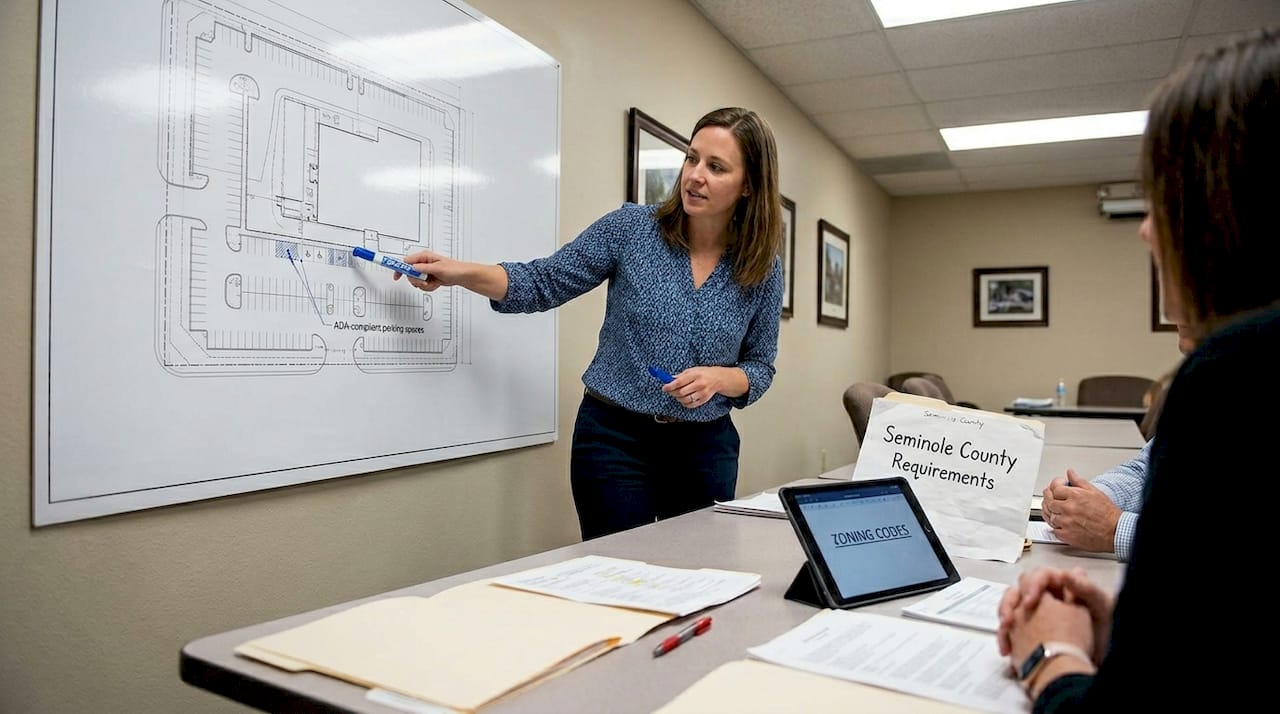
As zoning requirements in Seminole County outline, site plans must show driveways, sidewalks, parking with ADA compliance, access points, turning radii for commercial vehicles, and a zoning table listing setbacks required versus provided, lot coverage, building height, and impervious surface ratio.
| Item | Residential | Commercial |
|---|---|---|
| Driveway width | 10 to 20 ft typical | 24 ft minimum (two-way) |
| ADA parking | Not required | Required per IBC standards |
| Turning radius | Not required | Required for trucks/fire access |
| Sidewalk connection | Required in most counties | Required with ADA ramp |
| Zoning table | Setbacks and lot coverage | Full table with height and ISR |
| Setback notation | Front, rear, side | All sides plus buffers |
Common zoning pitfalls that catch property owners off guard:
- Forgetting to label both required and provided setback dimensions
- Missing the impervious surface ratio calculation on the plan sheet
- Omitting the driveway apron connection to the public right-of-way
- Failing to show ADA-compliant parking space dimensions and signage notes
Review site plan examples from similar projects in your county before finalizing your layout. Seeing how approved plans handle zoning tables and parking layouts gives you a practical benchmark that no checklist alone can provide.
Accurate dimensions matter more than you might expect. A setback shown as 25 feet that actually measures 24.8 feet on the survey will trigger a correction. Always cross-reference your site plan against the current survey before submission.
Special considerations and supporting documents
Standard checklist items get most projects through the door, but Florida’s environmental diversity and development history mean many sites carry extra requirements. Missing one of these supporting documents is one of the most common reasons for a second or third submission cycle.
Here are the special conditions that trigger additional documentation:
- Wetland areas: If your property is near or contains wetlands, you need a jurisdictional determination from the Army Corps of Engineers or the Florida Department of Environmental Protection. Wetland approvals have validity periods, often five years, so confirm yours is current.
- Infill lots: Older platted lots may have drainage or grading conflicts with surrounding developed properties. A grading analysis showing compatibility with adjacent finished grades is often required.
- Flood zones: Properties in FEMA flood zones need BFE documentation, freeboard calculations, and sometimes a no-rise certificate if work is in a floodway.
- Tree protection: Many Florida counties require a tree survey and protection plan before any land clearing begins.
- Seawall permits: Coastal and waterfront properties need separate permits for seawall construction or repair.
- Septic approval: If the property uses an on-site sewage treatment system, environmental health approval from the county health department must be obtained before building permit issuance.
As the site plan checklist (Martin County) specifies, submissions must include an owner/builder affidavit if applicable, lot coverage calculations, impervious surface ratio, and environmental health approval for septic systems.
| Trigger condition | Required document | When needed |
|---|---|---|
| Wetlands on or near site | Jurisdictional determination | Before site plan approval |
| FEMA flood zone | BFE documentation, no-rise cert | With site plan submission |
| On-site septic system | Environmental health approval | Before building permit |
| Significant trees on site | Tree survey and protection plan | Before land clearing |
| Waterfront/coastal lot | Seawall permit | Separate from building permit |
| Owner acting as contractor | Owner/builder affidavit | With permit application |
Review the site plan drafting guide to understand how these supporting documents get incorporated into your full submission package. Missing a wetland approval or a septic sign-off can delay your project by months, not weeks.
What most Florida guides miss about site plan checklists
Here is the uncomfortable truth: most published Florida site plan checklists are starting points, not finish lines. Every county in Florida operates under the state Florida Building Code, but local amendments layer on top of that foundation. What passes in Orange County may get rejected in Broward County, even when the plans look identical.
We see this constantly. A developer uses a checklist from one county for a project in another, and the reviewer sends it back because fire access lane widths or concurrency management documentation was not included. These are not obscure requirements. They are just not on the generic checklist the developer downloaded.
The other gap? Over-communication. Reviewers appreciate plans that anticipate their questions. If your lot has an unusual shape, add a note explaining how setbacks were calculated. If you’re in a flood zone, call out your FFE and BFE prominently, not buried in a data table. Think about Florida blueprints as a conversation with the reviewer, not just a technical deliverable. The projects that sail through permitting are the ones where the engineer clearly thought about what the reviewer needs to see.
Get expert help with your Florida site plan checklist
If this checklist feels like a lot to manage on your own, you are not alone. Florida’s permitting landscape is genuinely complex, and the cost of a rejected submission goes beyond the resubmittal fee.

Our team provides full engineering services overview for residential and commercial projects across Florida, including site plans, grading and drainage design, flood analysis, elevation certificates, and permitting expediter services. We know what reviewers look for because we work with them regularly. Explore how engineers in permitting can streamline your approval timeline, or contact our Florida engineering experts directly to discuss your project needs.
Frequently asked questions
What documents are typically required for a Florida site plan submission?
Site plans must include a drawn-to-scale map with a north arrow, scale bar, title block, legal description, and vicinity map, plus grading, drainage, access, zoning details, and any applicable supporting documents like affidavits or lot coverage calculations.
How do flood zone requirements affect my site plan in Florida?
Flood zones require BFE and FFE documentation on your site plan, and coastal properties may also need separate seawall permits and no-rise certificates before approval.
What is impervious surface ratio (ISR), and why is it important?
ISR measures how much of your lot is covered by hard surfaces like concrete and asphalt, and as Martin County requires, it must be calculated and shown on your site plan because it directly affects drainage capacity and building approval.
Do commercial site plans require different items than residential projects?
Yes, commercial plans add fire access lanes, ADA parking layouts, turning radii, occupancy separation notes, and sometimes soils reports, going well beyond what a residential site plan typically requires.
How often do Florida site plan requirements change?
The Florida Building Code updates on a set cycle, but local amendments and special rules for unique lot conditions can shift more frequently, so always pull the current checklist directly from your city or county before submitting.


