
Structural Analysis: Everything You Need to Know
Even the most breathtaking buildings rely on invisible science to stay safe and strong. Structural analysis gives engineers powerful insight into how a structure responds to every force it faces, from roaring winds to everyday foot traffic. With one small miscalculation able to trigger catastrophic failures and legal nightmares, understanding this process matters for anyone involved in construction or property investment. Here you will discover exactly how structural analysis works, why it safeguards safety, and what professionals do to get it right.
Table of Contents
- What Structural Analysis Involves
- Major Types of Structural Analysis Methods
- How Structural Analysis Ensures Safety and Compliance
- Structural Analysis In Real-World Projects
- Risks, Legal Liabilities, And Common Mistakes
Key Takeaways
| Point | Details |
|---|---|
| Structural Analysis Objectives | It assesses a structure’s capacity to endure loads and ensures compliance with safety standards. |
| Key Analysis Methods | The main methods include classical (force and displacement), matrix, and finite element approaches for evaluating structures. |
| Safety and Compliance Assurance | Structural analysis identifies vulnerabilities and verifies load-bearing capabilities to adhere to regulatory standards. |
| Risks and Legal Liabilities | Errors in structural analysis can result in significant safety risks and legal consequences; meticulous attention to detail is crucial. |
What Structural Analysis Involves
Structural analysis is a sophisticated engineering process that critically examines how buildings and structures respond to various loads and environmental forces. According to architecturecourses, it involves “assessing a structure’s ability to withstand loads, ensuring safety and performance” by evaluating forces, stresses, and potential deformations.
Structural analysis fundamentally determines whether a construction can safely support its intended purpose without risking catastrophic failure. Meegle explains that this process involves “determining the effects of loads on physical structures and their components” while considering critical factors like material properties and geometric characteristics.
The primary objectives of structural analysis include:
- Identifying potential stress points in a structure
- Calculating maximum load capacities
- Predicting potential deformation under different conditions
- Ensuring compliance with safety engineering standards
Engineers use advanced computational tools and mathematical models to simulate how structures will perform under various scenarios. These simulations help predict potential weaknesses, recommend reinforcement strategies, and ultimately design buildings that can withstand expected environmental challenges.
 By meticulously analyzing potential stress factors, structural engineers create frameworks that balance safety, durability, and economic considerations.
When conducting structural analysis, professionals typically examine several key components:
- Material strength and characteristics
- Applied external loads (wind, earthquakes, snow)
- Structural geometry and configuration
- Connection points and potential failure mechanisms
For a deeper understanding of how these principles are applied in real-world scenarios, check out our comprehensive structural inspections guide.
Major Types of Structural Analysis Methods
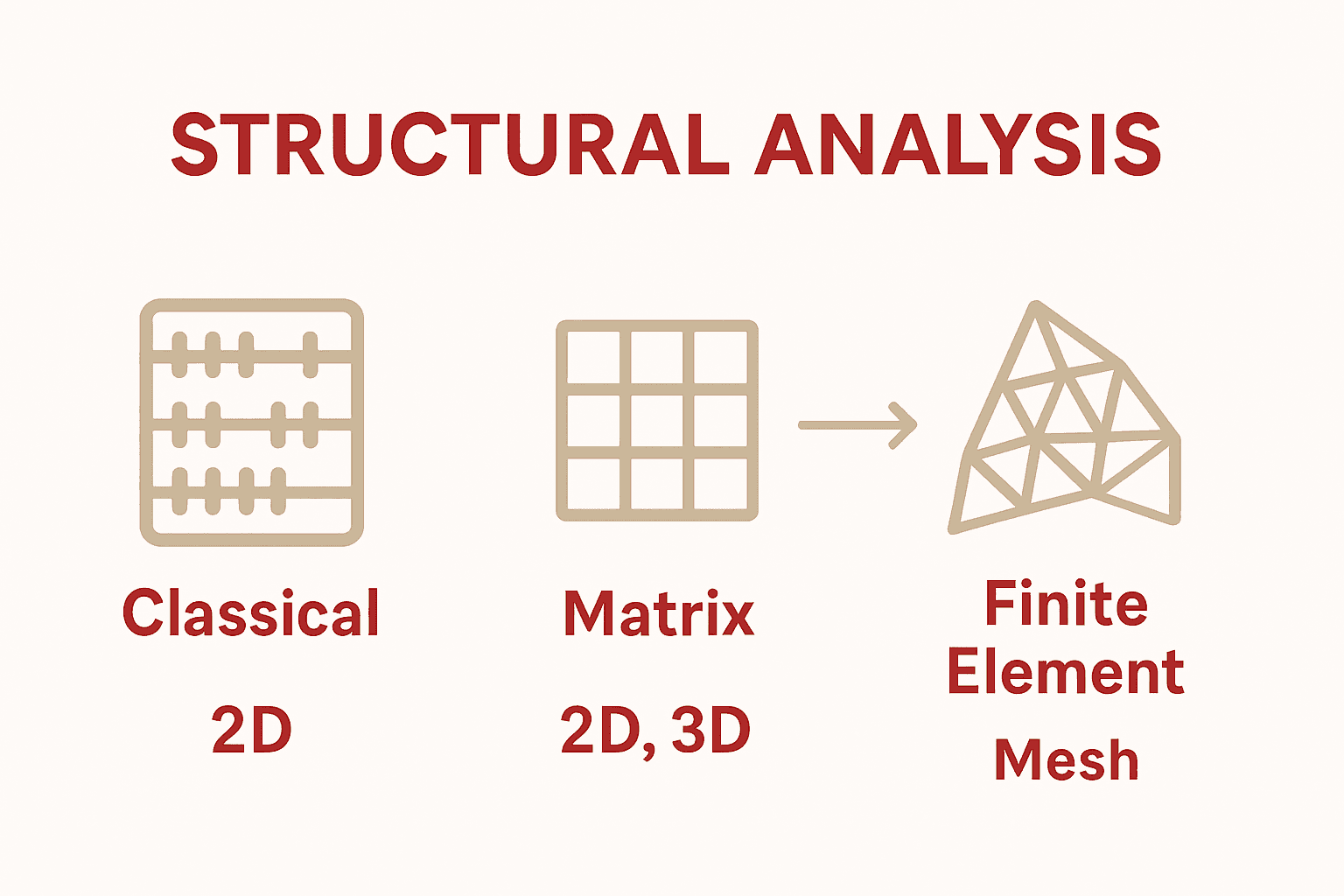
Structural analysis encompasses several sophisticated methods engineers use to understand and predict how structures will perform under various conditions. According to wethestudy, these methods can be broadly classified into three primary categories: classical, matrix, and finite element approaches, each evolving to address increasingly complex structural challenges.
The classical methods represent foundational techniques in structural engineering. ijraset highlights two critical classical approaches: the force method and the displacement method. These techniques help engineers analyze statically indeterminate structures by systematically evaluating internal forces and potential deformations.
Key structural analysis methods include:
- Force Method: Focuses on determining unknown forces within a structure
- Displacement Method: Calculates structural deformations and displacement
- Matrix Method: Utilizes algebraic matrices to analyze structural behavior
- Finite Element Method: Breaks complex structures into smaller, manageable elements for detailed analysis
Modern structural analysis increasingly relies on advanced computational techniques.
 Engineers now use sophisticated software and numerical modeling to simulate complex scenarios that were previously impossible to predict. These methods allow for more precise calculations, considering intricate factors like material properties, load distributions, and potential environmental stresses.
Professionals select analysis methods based on specific project requirements, structure complexity, and available computational resources. For those interested in understanding how technology supports these critical engineering processes, our guide on structural analysis software for architects provides deeper insights into the tools transforming modern structural engineering.
How Structural Analysis Ensures Safety and Compliance
Structural analysis is a critical process that serves as the primary safeguard for building integrity and public safety. According to architecturecourses, this process ensures safety “by evaluating a structure’s response to loads, identifying potential weaknesses, and guiding design modifications to meet safety standards and compliance requirements.”
The safety verification process involves comprehensive examination of multiple critical factors. Meegle emphasizes that structural analysis helps “in designing structures that comply with safety regulations, preventing failures and ensuring the well-being of occupants” through meticulous force and stress analysis.
Key safety and compliance aspects include:
- Identifying potential structural vulnerabilities
- Predicting potential failure points
- Verifying load-bearing capabilities
- Ensuring adherence to building codes and regulations
- Minimizing risks of structural deterioration
Professional engineers employ multiple strategies to guarantee structural safety, including detailed computational modeling, stress simulations, and material strength assessments. These sophisticated techniques allow for proactive identification of potential issues before they become critical, ultimately protecting both human lives and significant financial investments.
The compliance process requires rigorous documentation and systematic evaluation. Different structures demand unique analysis approaches, ranging from residential buildings to complex industrial facilities. To gain deeper insights into the comprehensive approach professionals use, explore our structural inspection guide for safe buildings.
Structural Analysis in Real-World Projects
Structural analysis plays a pivotal role in transforming architectural concepts into safe, sustainable realities. Meegle highlights its critical importance in designing complex structures like “skyscrapers, bridges, and offshore platforms,” ensuring they can withstand diverse environmental challenges and loading conditions.
In practical engineering applications, computational modeling has revolutionized how professionals approach structural design. Architecturecourses emphasizes that structural analysis now helps “in modeling and simulating structures to predict their behavior under different scenarios, aiding in the design of safe and efficient buildings.”
Real-world project applications include:
- High-rise building design and stability assessment
- Bridge engineering and infrastructure development
- Offshore platform construction
- Earthquake-resistant structure design
- Industrial facility structural integrity analysis
Modern structural analysis integrates advanced technologies like 3D modeling, finite element analysis, and sophisticated simulation software. These tools enable engineers to predict potential structural vulnerabilities, optimize material usage, and create more resilient designs that can withstand extreme environmental conditions.
Engineers must consider multiple complex factors during real-world structural analysis, including geological conditions, environmental impacts, and specific project requirements. For professionals seeking comprehensive insights into practical structural engineering approaches, our guide on essential structural engineering project examples provides in-depth perspectives on current industry practices.
Risks, Legal Liabilities, and Common Mistakes
Structural analysis involves complex engineering processes where even minor errors can have catastrophic consequences. ijraset underscores the critical nature of accurate analysis, particularly in seismic zones, where “errors can lead to structural failures, resulting in legal liabilities and safety risks.”
According to architecturecourses, common mistakes in structural analysis frequently stem from “overlooking load combinations and material properties, which can lead to design flaws, safety hazards, and potential legal consequences.”
Key risks and potential mistakes include:
- Inadequate load calculations
- Misinterpreting material strength characteristics
- Overlooking environmental stress factors
- Incomplete seismic zone considerations
- Insufficient documentation of analysis processes
Legal liabilities in structural engineering can be extensive and financially devastating. Professional engineers can face significant legal repercussions for design failures, including potential lawsuits, professional license revocation, and criminal negligence charges. The financial and reputational damage from structural analysis errors can far exceed the initial project costs.
Mitigating these risks requires meticulous attention to detail, continuous professional education, and implementing rigorous quality control processes. For professionals seeking comprehensive guidance on avoiding potential pitfalls, our structural report breakdown guide offers critical insights into maintaining the highest standards of professional practice.
Ensure Your Project’s Safety with Expert Structural Analysis Support
Understanding the complexities of structural analysis is essential to guarantee your building’s safety and compliance. This article highlights common challenges such as accurate load calculations, material strength evaluation, and legal liabilities that can arise from oversight. If you want to avoid costly mistakes and protect your investment, expert guidance is crucial. Our team at Texas Structural Inspectors specializes in thorough structural inspections and detailed analysis to identify potential weaknesses before they become critical.

Don’t leave your structural integrity to chance. Get professional engineering services tailored to residential and commercial needs including inspections, blueprints, and comprehensive reports. Visit Florida Licensed Engineers now to secure your project’s safety, ensure regulatory compliance, and benefit from trusted expertise. Act today to safeguard your investment and peace of mind with industry-leading service.
Frequently Asked Questions
What is structural analysis?
Structural analysis is an engineering process that assesses how buildings and structures respond to various loads and environmental forces, ensuring they can safely support their intended purpose and comply with safety standards.
What are the primary objectives of structural analysis?
The main objectives of structural analysis include identifying potential stress points in a structure, calculating maximum load capacities, predicting potential deformation under varying conditions, and ensuring compliance with safety engineering standards.
What are the major types of structural analysis methods?
The major types of structural analysis methods include classical methods (force and displacement methods), matrix methods, and finite element methods, each tailored to analyze different complexities in structural design.
How does structural analysis ensure safety and compliance in engineering?
Structural analysis ensures safety and compliance by evaluating a structure’s response to loads, identifying potential weaknesses, verifying load-bearing capabilities, and ensuring adherence to building codes and regulations.
Recommended
- Structural Inspections: Everything You Need to Know – FloridaLicensedEngineers.com
- What Is Structural Assessment? Complete Overview – FloridaLicensedEngineers.com
- Structural Report Breakdown: Complete Guide for 2025 – FloridaLicensedEngineers.com
- 7 Essential Steps for a Complete Structural Engineering Checklist – FloridaLicensedEngineers.com
