
Engineering Services Overview: Complete Guide for 2025
Welcome to our complete guide to engineering services, where we explore the essential roles engineers play in planning, designing, and managing construction projects. Whether you’re a homeowner, contractor, or developer, this guide explains how licensed engineers ensure safety, efficiency, and compliance at every stage.
Did you know that nearly 90 percent of major construction projects rely on specialized engineering services to meet regulatory and safety standards? This engineering services overview explains how licensed engineers support every stage of construction — from planning and design to inspections and project completion.
In this engineering services overview, we’ll explore the essential services offered by Florida Licensed Engineers — helping you understand how certified experts ensure safety, compliance, and efficiency in every project. Engineering is not just about crunching numbers, it shapes the structures and systems we use every day. Whether for residential buildings or vast infrastructure, understanding what engineering services include helps you make well-informed decisions and avoid costly setbacks as you bring your vision to life. In this engineering services overview, we’ll explain how licensed engineers support every stage of project development.
Key Considerations in Our Complete Guide to Engineering Services
| Point | Details |
| Comprehensive Engineering Services | Engineering services are essential for transforming theoretical concepts into practical solutions, requiring specialized skills and knowledge across various disciplines. |
| Core Disciplines | Key areas include civil, mechanical, electrical, structural, and industrial engineering, addressing distinct real-world challenges. |
| Blueprints and Inspections | Effective project execution relies on detailed blueprints, rigorous inspections, and adherence to permitting standards to ensure safety and compliance. |
| Risk Management | Proactive risk assessment and legal compliance are vital for minimizing financial liabilities and enhancing project quality and safety. |
Table of Contents
- Defining Engineering Services And Core Concepts
- Types Of Engineering Services Provided
- Blueprints, Inspections, And Permitting Explained
- Civil, Structural, And Forensic Applications
- Risks, Legal Compliance, And Cost Factors
Defining Engineering Services and Core Concepts
Engineering services represent far more than just technical work—they are the critical bridge between complex scientific knowledge and real-world problem solving. Engineering services encompass professional work that transforms theoretical concepts into practical solutions across residential, commercial, and infrastructure projects. This comprehensive engineering services overview will help clients understand our range of professional expertise.
According to legal definitions, engineering services involve professional creative work requiring specialized education, training, and experience in mathematical, physical, and engineering sciences. This definition highlights the multifaceted nature of engineering, which goes beyond simple calculations to include:
- Consultation with clients about project requirements
- Investigation of site conditions and potential challenges
- Evaluation of design feasibility and potential solutions
- Planning comprehensive project strategies
- Design of technical blueprints and specifications
- Supervision of construction to ensure compliance
At its core, engineering services provide structured approaches to solving complex technical challenges. Whether designing a residential foundation, planning municipal infrastructure, or developing mechanical systems for commercial buildings, engineers apply rigorous scientific principles to transform abstract concepts into tangible, functional realities. Each project requires careful analysis, innovative thinking, and precise execution to meet safety standards, regulatory requirements, and client expectations.
Types of Engineering Services Provided
Engineering is a diverse field with specialized services spanning multiple disciplines. According to research from Northwestern University, the primary branches of engineering encompass a wide range of technical expertise designed to solve complex real-world challenges. Our engineering services overview covers everything from planning to design and inspection.
Core Engineering Disciplines
The main engineering service categories include:
- Civil Engineering: Infrastructure development, including roads, bridges, water systems
- Mechanical Engineering: Design of mechanical systems, machinery, and equipment
- Electrical Engineering: Power systems, electronic networks, and electrical infrastructure
- Structural Engineering: Building design, foundation analysis, and construction safety
- Industrial Engineering: Process optimization and system design
Specialized Engineering Services
Here’s a summary comparison of core and specialized engineering service disciplines:
| Discipline Type | Main Focus Areas | Example Services |
| Core Engineering | Infrastructure Mechanical Systems Electrical Networks |
Road & Bridge Design Machine Engineering Power System Layout |
| Specialized Engineering | Advanced Technologies Sector-Specific Solutions |
Aerospace Systems Biomedical Devices Marine Structures |
Beyond core disciplines, engineers provide highly specialized services in emerging fields such as:
- Aerospace engineering for advanced transportation systems
- Biomedical engineering supporting healthcare technologies
- Marine engineering for maritime infrastructure
- Automotive engineering focused on transportation solutions
- Systems engineering integrating complex technological frameworks
At Florida Licensed Engineers, our team offers comprehensive engineering services that cover these critical disciplines. We understand that each project requires a unique approach, blending scientific precision with innovative problem solving. Whether you’re developing a residential complex, planning municipal infrastructure, or designing cutting-edge technological systems, our engineers bring specialized expertise to transform your vision into reality.
Blueprints, Inspections, and Permitting Explained
Blueprints, inspections, and permitting form the critical foundation of any successful engineering project, transforming conceptual designs into actionable, compliant construction plans. According to detailed engineering research, these processes provide comprehensive documentation of every project aspect before construction begins.
The Blueprint Process
Blueprints are intricate technical drawings that serve as the project’s roadmap. They include:
- Precise architectural and structural designs
- Detailed mechanical and electrical system layouts
- Comprehensive site plans and dimensional specifications
- Cost schedules and material requirements
- Environmental impact assessments
Inspections and Permitting Explained
As highlighted by international engineering standards, infrastructure service guidelines emphasize that inspections are crucial for ensuring:
- Compliance with design specifications
- Adherence to safety regulations
- Quality standards across construction phases
- Third-party verification of project elements
The permitting process acts as a regulatory checkpoint, requiring official approval from local authorities to validate that all proposed work meets municipal, state, and federal guidelines. This multi-step verification ensures public safety, structural integrity, and legal compliance for every construction project. By meticulously documenting and validating each stage, engineers provide clients with confidence that their projects will be executed professionally and safely.

Civil, Structural, and Forensic Applications
Civil engineering represents a critical discipline that transforms landscapes and infrastructure through comprehensive technical solutions. Geotechnical research reveals the complex underpinnings of these services, which extend far beyond simple construction projects.
Civil Engineering Services
Civil engineering encompasses a broad spectrum of critical infrastructure development, including:
- Subsurface geological studies
- Foundation design and analysis
- Earth retention structure planning
- Pavement and transportation infrastructure development
- Utility system design and implementation
Structural and Forensic Investigations
Forensic engineering takes technical analysis to an entirely new level. According to specialized forensic consulting research, these investigations dive deep into understanding structural failures through:
- Comprehensive structural integrity assessments
- Detailed failure mode analysis
- Moisture intrusion investigations
- Geotechnical evaluations
- Bridge and critical infrastructure damage analysis
- Disaster and weather event impact studies
Whether preventing potential structural issues or investigating past failures, our engineering team provides meticulous, data-driven solutions that prioritize safety, reliability, and long-term infrastructure performance. We transform complex technical challenges into actionable insights that protect both property and human life.
Risks, Legal Compliance, and Cost Factors
Engineering risk management is a critical process that goes far beyond simple technical assessments. According to compliance research, the financial implications of proper risk management can be substantial, with potential costs of non-compliance dramatically outweighing initial investment in professional engineering services. As part of our engineering services overview, we detail how compliance and safety standards are maintained.
Key Risk Management Considerations
Legal compliance in engineering involves multiple crucial elements:
- Comprehensive regulatory standard adherence
- Systematic safety protocol implementation
- Proactive risk identification and mitigation
- Detailed documentation of engineering processes
- Continuous quality control and verification
Financial and Legal Implications
As highlighted by engineering services legal overview, contracting qualified engineering expertise provides multiple strategic advantages:
- Reduced project liability risks
- Enhanced structural and operational safety
- Optimization of resource allocation
- Protection against potential legal penalties
- Improved overall project quality and reliability
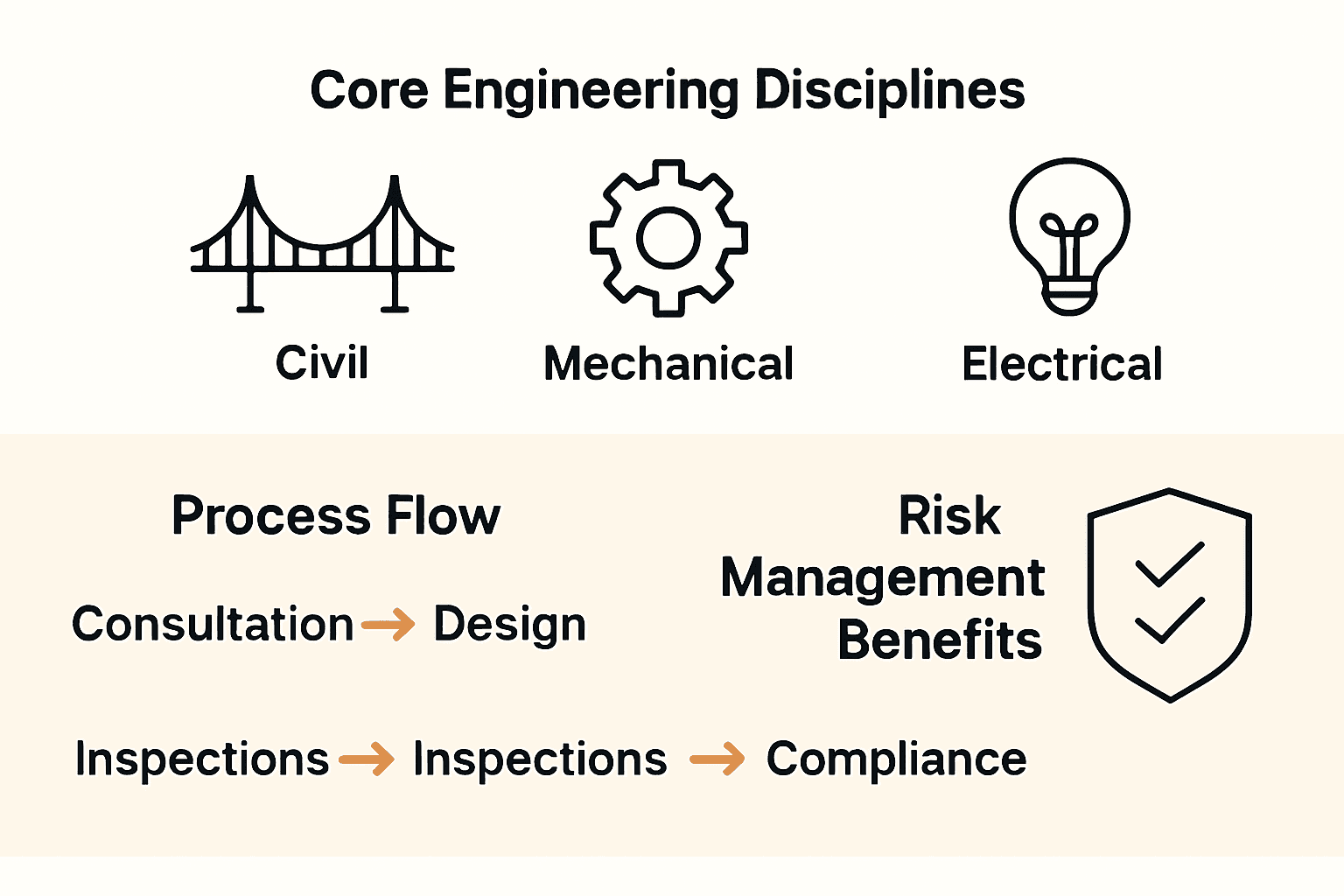
Understanding that each engineering project carries inherent risks, our approach focuses on comprehensive risk assessment, meticulous planning, and proactive compliance strategies. We transform potential challenges into manageable, strategic opportunities, ensuring that your project meets the highest standards of safety, efficiency, and legal compliance.
Conclusion: Transform Your Next Project With Expert Engineering Solutions
By following this complete guide to engineering services, clients can make informed decisions when hiring licensed engineers for their projects. If you are feeling overwhelmed by the complexity of engineering requirements such as inspections, blueprints, permitting, or navigating legal compliance, you are not alone. From ensuring your project meets safety standards to managing the intricate steps of risk assessment and site planning, the path to successful construction can seem daunting. The article clarified how every stage—consultation, design, permitting, and forensic analysis—is absolutely essential for a safe and legal outcome, whether you are planning residential or commercial work.

Why take on these challenges alone? Rely on the team at Florida Licensed Engineers for complete engineering support, including architectural, mechanical, electrical, and civil services. We also make the permitting process easier and resolve complex forensic investigations fast. Your project gets the expertise it deserves from first plans to final inspection. Contact us today to make your next project worry-free and compliant from the ground up—explore our solutions or reach out now at Florida Licensed Engineers to get started with a quote or free consultation.
Frequently Asked Questions
What are engineering services?
Engineering services involve professional work that transforms theoretical concepts into practical solutions, encompassing consultation, investigation, evaluation, planning, design, and supervision in various fields such as civil, mechanical, electrical, and structural engineering.
What types of engineering disciplines are included in engineering services?
Engineering services include core disciplines like civil, mechanical, electrical, structural, and industrial engineering, as well as specialized areas such as aerospace, biomedical, marine, and automotive engineering.
Why are blueprints important in engineering projects?
Blueprints are crucial because they provide detailed technical drawings that serve as a roadmap for construction, including architectural designs, system layouts, material specifications, and environmental assessments.
How does risk management impact engineering services?
Risk management in engineering is vital as it ensures compliance with regulatory standards, promotes safety protocol implementation, and helps mitigate potential project liabilities, ultimately leading to improved quality and reliability of engineering projects.
