
Role of Civil Engineer in Construction Explained
Every day, we rely on roads, bridges, and clean water without a second thought, yet over 40 percent of global infrastructure is at risk due to aging or inadequate design. Behind the scenes, civil engineers make sure these vital systems work safely and efficiently. Their expertise shapes the foundation of cities, protects public health, and solves complex problems that affect millions. Understanding what civil engineers do reveals just how much communities depend on their skill and dedication.
Key Takeaways
| Point | Details |
|---|---|
| Role of Civil Engineers | Civil engineers design, construct, and maintain essential infrastructure, ensuring public and environmental health. |
| Project Management Phases | Their responsibilities span pre-construction, construction, and post-construction phases, requiring technical and collaborative skills. |
| Specializations | Civil engineering encompasses multiple specializations, including construction, geotechnical, and environmental engineering, each addressing unique infrastructure needs. |
| Compliance and Safety | Adherence to safety standards and regulatory requirements is crucial, with engineers managing risks and ensuring the longevity of infrastructure projects. |
Table of Contents
- Defining The Role Of Civil Engineer
- Key Responsibilities In Construction Projects
- Types Of Civil Engineers And Specializations
- Project Phases And Civil Engineer Functions
- Compliance, Regulations, And Safety Standards
- Common Challenges And Avoidable Pitfalls
Defining the Role of Civil Engineer
Civil engineers are the masterminds behind the infrastructure that supports our daily lives. Civil engineering is a professional discipline focused on designing, constructing, and maintaining critical public infrastructure that keeps communities functioning smoothly. According to Britannica, this profession encompasses an incredibly broad range of structural works serving public needs.
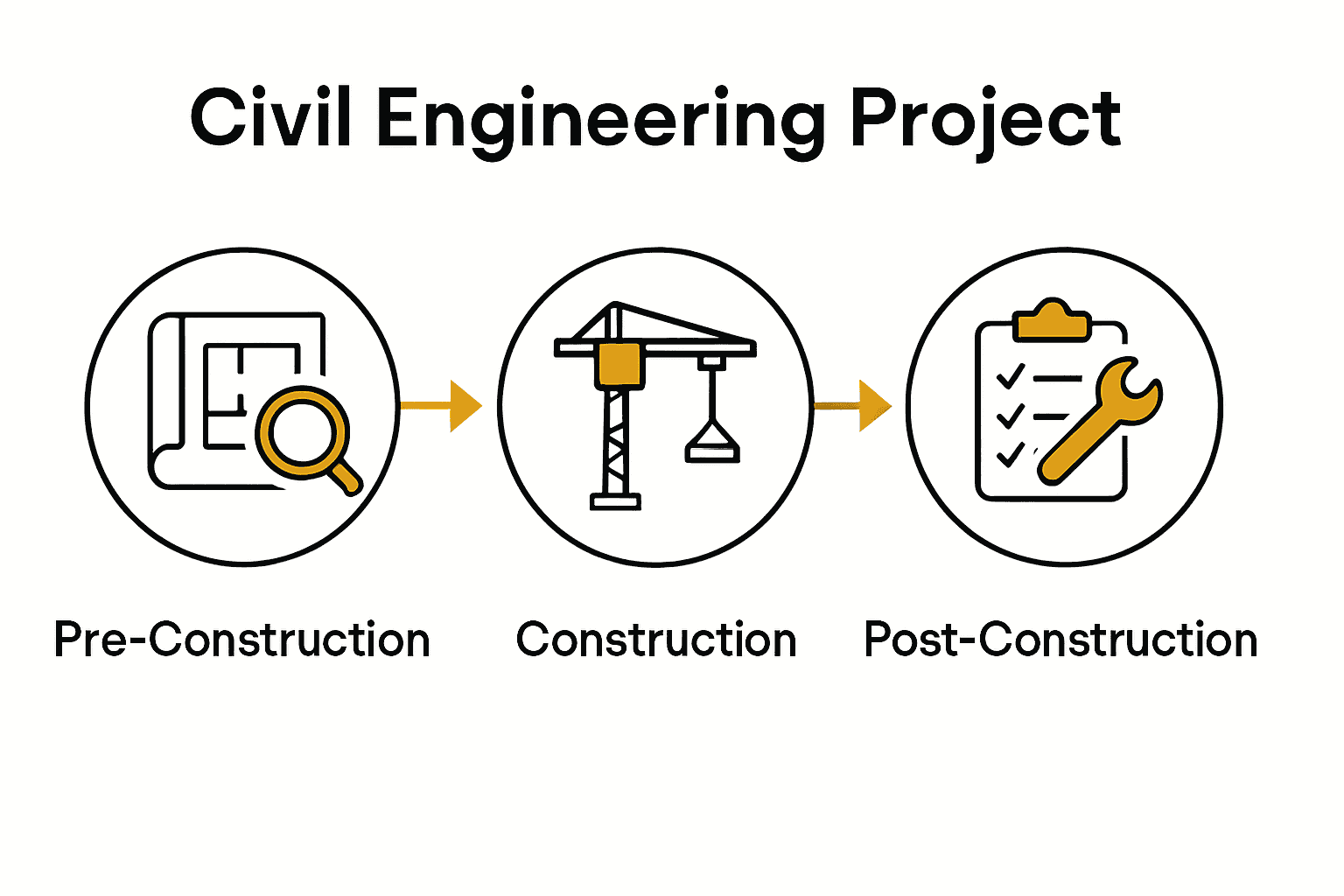
The role of a civil engineer extends far beyond simply drawing blueprints. These professionals are responsible for comprehensive project management across multiple stages:
- Pre-Construction Phase: Conducting feasibility studies, performing site investigations, and creating detailed infrastructure designs
- Construction Phase: Coordinating with clients, contractors, and other engineers to ensure project implementation
- Post-Construction Phase: Managing ongoing maintenance, conducting research, and ensuring long-term infrastructure performance
As Wikipedia explains, civil engineers play a critical role in protecting public and environmental health through strategic infrastructure development. Their typical projects include complex systems like roads, bridges, airports, water networks, and sewage systems that form the backbone of modern communities. Read more about licensed civil engineers to understand the depth of expertise required in this essential profession.
Key Responsibilities in Construction Projects
Construction projects require civil engineers to be multifaceted professionals who manage complex technical and logistical challenges throughout project lifecycles. According to Procore, civil engineers perform critical assessments and design work that form the foundation of successful infrastructure development.
Before construction begins, civil engineers shoulder multiple crucial responsibilities:
- Site Assessment: Thoroughly evaluating terrain, soil conditions, and environmental factors
- Foundation Design: Creating robust structural plans that ensure long-term stability
- Grading and Drainage: Designing systems that manage water flow and prevent potential structural issues
- Structural Analysis: Conducting detailed mathematical and technical evaluations to guarantee design integrity
During the active construction phase, civil engineers transform from designers to hands-on project managers. They coordinate between multiple stakeholders, ensuring that every aspect of the project meets stringent specifications and safety standards. This involves adapting to unexpected site conditions, managing potential risks, and consistently bridging the gap between original design intent and practical execution. Learn more about our construction administration services to understand the depth of expertise required in these complex projects.
Their role is not just technical but also collaborative.
 Civil engineers must communicate effectively with contractors, architects, and clients, translating complex engineering concepts into actionable plans that balance technical precision with practical feasibility.
Types of Civil Engineers and Specializations
Civil engineering is a diverse field with multiple specialized branches, each focusing on unique aspects of infrastructure and environmental design. According to Wikipedia, civil engineers typically practice in several distinct specializations that address complex societal and technological challenges.
The primary specializations in civil engineering include:
- Construction Engineering: Focused on project management and construction processes
- Geotechnical Engineering: Analyzing soil and rock mechanics for infrastructure stability
- Structural Engineering: Designing load-bearing structures and ensuring architectural integrity
- Transportation Engineering: Planning and designing transportation systems and networks
- Hydraulic Engineering: Managing water resources, designing drainage, and flood control systems
- Environmental Engineering: Developing sustainable solutions and managing ecological impacts
As Ikigai Consulting explains, many civil engineers collaborate across these specializations, particularly for critical infrastructure projects. Their involvement spans the entire project lifecycle – from initial design and feasibility studies through procurement, construction supervision, and final certification.
VIDEO:video_content] [Learn more about our licensed civil engineering services to understand the breadth of expertise required in this dynamic profession.
These specializations are not isolated silos but interconnected disciplines. A transportation engineer might collaborate with environmental engineers to design eco-friendly roadways, while a structural engineer works closely with geotechnical experts to ensure foundation stability. This collaborative approach ensures comprehensive, innovative solutions that meet modern infrastructure challenges.
Here’s a summary of the main civil engineering specializations:
| Specialization | Core Focus Area | Typical Projects |
|---|---|---|
| Construction Engineering | Project management Construction processes |
Building sites Infrastructure projects |
| Geotechnical Engineering | Soil & rock analysis | Foundations Dams Tunnels |
| Structural Engineering | Structural design Integrity |
Bridges Skyscrapers Stadiums |
| Transportation Engineering | Transportation systems Network planning |
Roads Highways Airports |
| Hydraulic Engineering | Water resources Drainage |
Water supply Flood control |
| Environmental Engineering | Eco-solutions Impact mitigation |
Waste treatment Pollution control |
Project Phases and Civil Engineer Functions
Civil engineering projects involve intricate processes spanning multiple phases, with engineers playing critical roles at each stage. According to Britannica, these phases include pre-construction, active construction, and post-construction periods, each demanding unique skills and strategic interventions.
In the pre-construction phase, civil engineers perform several crucial tasks:
- Conducting comprehensive site investigations
- Performing detailed environmental assessments
- Creating precise design plans and technical specifications
- Developing cost estimates and project feasibility reports
- Identifying potential risks and mitigation strategies
During the active construction phase, as Procore explains, civil engineers transform into hands-on project managers. They monitor quality control, adapt to unexpected site challenges, and maintain constant communication with construction managers and contractors. Their responsibilities include ensuring design specifications are meticulously followed, managing technical complexities, and solving real-time engineering problems that emerge during implementation. Learn more about our licensed civil engineering services to understand the depth of expertise required.
The post-construction phase is equally critical. Civil engineers help close out projects by validating compliance, managing final documentation, conducting comprehensive risk assessments, and establishing long-term maintenance protocols. This final stage ensures the infrastructure meets all technical, safety, and regulatory standards, ultimately protecting public interests and guaranteeing the project’s long-term viability.
Compliance, Regulations, and Safety Standards
Safety standards are the cornerstone of civil engineering, transforming technical designs into reliable, secure infrastructure that protects public welfare. According to Procore, civil engineers play a critical role in enforcing regulatory requirements, managing complex risk landscapes, and adapting designs to meet evolving environmental and safety challenges.
Compliance in civil engineering encompasses multiple critical dimensions:
- Structural Integrity: Ensuring all designs meet minimum safety load requirements
- Environmental Protection: Implementing solutions that minimize ecological disruption
- Legal Compliance: Adhering to local, state, and federal construction regulations
- Risk Management: Identifying and mitigating potential hazards before and during construction
- Technical Standards: Following industry-approved engineering guidelines and best practices
Civil engineers must be proactive problem solvers, constantly monitoring project conditions and making real-time adjustments to maintain safety standards. This involves continuous site assessments, detailed documentation, and collaborative communication with stakeholders to address any emerging risks or regulatory concerns. Explore our comprehensive engineering compliance services to understand how professional oversight ensures project success.
Beyond immediate project requirements, compliance represents a broader commitment to public safety and sustainable development. Civil engineers serve as critical gatekeepers, translating complex technical specifications into practical, safe, and environmentally responsible infrastructure that supports community growth and protects human lives.
Common Challenges and Avoidable Pitfalls
Construction challenges are inevitable in civil engineering, requiring professionals to be adaptable and strategic problem solvers. According to Procore, civil engineers frequently encounter unexpected site conditions that demand immediate and innovative responses.
The most prevalent challenges in civil engineering projects include:
- Site Condition Discrepancies: Unexpected geological or environmental variations
- Resource Management: Navigating material shortages and budget constraints
- Stakeholder Coordination: Managing diverse team expectations and communication
- Technical Complexity: Resolving real-time design and implementation conflicts
- Regulatory Compliance: Maintaining standards while adapting to dynamic project requirements
As Ikigai Consulting explains, technical coordination across multiple teams presents significant challenges. Civil engineers must expertly respond to Requests for Information (RFIs), manage client-driven structural changes, and maintain project quality and timelines amid increasing complexity. Learn more about our risk management approaches to understand how professional engineers mitigate potential project pitfalls.
Successful navigation of these challenges requires a combination of technical expertise, communication skills, and proactive problem-solving. Civil engineers must remain flexible, continuously learn, and develop creative solutions that balance technical requirements, budget constraints, and stakeholder expectations.
Turn Your Construction Challenges Into Success With Civil Engineering Experts
When it comes to complex construction projects, the smallest misstep in grading, drainage, or permitting can lead to costly delays and compliance headaches. As highlighted in our article, navigating changing site conditions, meeting regulatory requirements, and translating technical plans into reality are critical pain points for both residential and commercial builders. If you have struggled with unclear blueprints or time-consuming inspection processes, you are not alone. These are the moments when the experience and versatility of licensed civil engineers matter most.

Now is the time to partner with professionals who simplify every phase of your project and help you avoid project-stalling pitfalls. Our team at Florida Licensed Engineers delivers full-spectrum support including civil engineering services, drainage and grading design, utility plans, site drainage, and permitting expediter solutions. Discover the difference that specialized plan preparation and forensic reporting can make for your construction timeline and peace of mind. Ready to take the worry out of your next build? Visit Florida Licensed Engineers to connect with our experts and move your project forward with confidence.
Frequently Asked Questions
What are the main responsibilities of a civil engineer?
Civil engineers are responsible for designing, constructing, and maintaining infrastructure projects. Their key responsibilities include conducting site assessments, creating design plans, managing construction processes, and ensuring safety and regulatory compliance throughout project lifecycles.
What types of projects do civil engineers typically work on?
Civil engineers typically work on a wide range of projects, including roads, bridges, airports, water networks, sewage systems, and other infrastructure that supports public needs and community development.
How do civil engineers ensure safety and compliance in construction projects?
Civil engineers ensure safety and compliance by following specific regulations, conducting thorough risk assessments, and implementing industry-approved guidelines during the design and construction phases. They continuously monitor site conditions and make adjustments as necessary to uphold safety standards.
What are the different specializations within civil engineering?
Civil engineering has several specializations, including construction engineering, geotechnical engineering, structural engineering, transportation engineering, hydraulic engineering, and environmental engineering. Each specialization focuses on unique aspects of infrastructure and environmental design.
