
Why use an engineering consultant for Florida projects

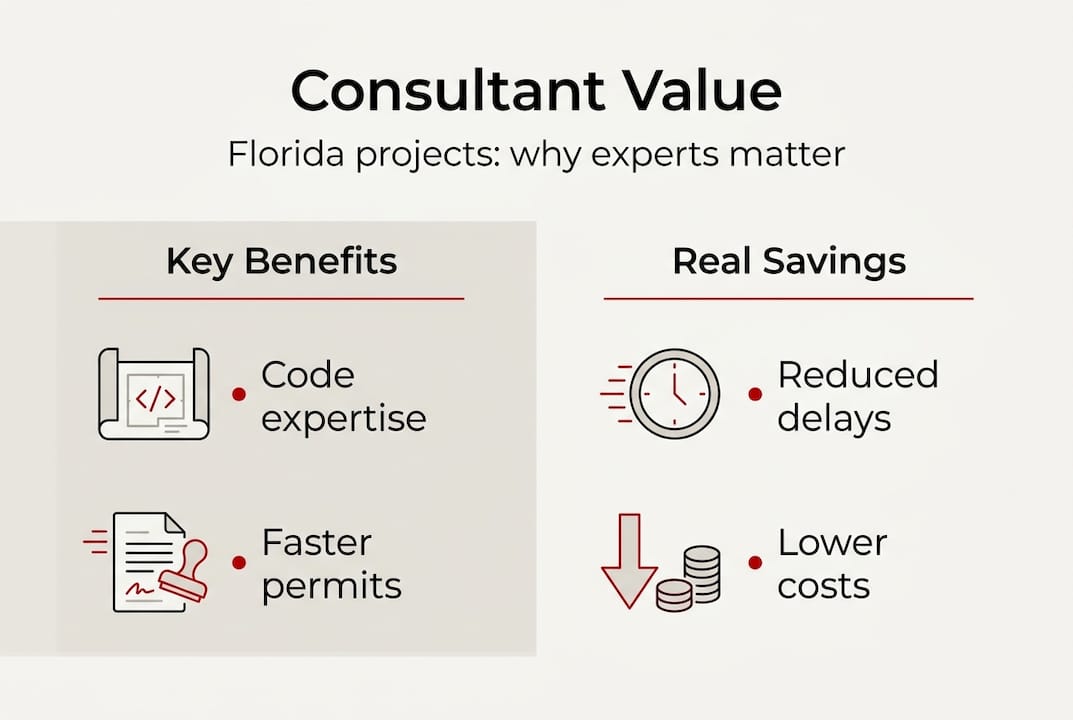
Many homeowners and business owners hesitate to hire an engineering consultant, viewing it as an added expense that bloats project budgets. The reality flips this assumption: consultants specializing in Florida construction deliver measurable savings by navigating the state’s complex building codes, expediting permitting, and preventing costly delays. From hurricane-resistant construction standards to county-specific approval processes, their expertise transforms regulatory hurdles into streamlined pathways. This article reveals how engineering consultants cut approval times by 50-100 days, slash permit fees by over 50%, and protect your investment from violations that derail projects.
Table of Contents
- Key takeaways
- Understanding the role of engineering consultants in Florida construction
- How engineering consultants speed up permitting and inspections in Florida
- Real-world time and cost savings from engineering consultants
- Balancing upfront costs with long-term value: the real ROI of engineering consultants
- Explore expert engineering services for your Florida project
- Frequently asked questions
Key Takeaways
| Point | Details |
|---|---|
| Florida code expertise | Consultants translate Florida Building Code and hurricane resistance standards into actionable designs to keep projects compliant from plan review through final inspections. |
| Fast track permitting | Private providers speed plan reviews and approvals, cutting permit fees by more than 50 percent and reducing approval times by 50 to 100 days. |
| Permit fee reductions | Early involvement prevents back and forth with authorities, helping avoid costly delays and code violations. |
| Long term risk reduction | Hiring a consultant pays off over time by preventing violations and keeping projects on schedule. |
Understanding the role of engineering consultants in Florida construction
Engineering consultants bring specialized knowledge that transforms how construction projects navigate Florida’s regulatory landscape. These professionals provide architectural, structural, mechanical, electrical, and plumbing plans tailored to state requirements. They handle inspections, blueprint preparation, and permitting expediter services that keep projects moving forward. For residential and commercial builds alike, consultants ensure every design element meets compliance standards before construction begins.
Florida’s building environment demands expertise beyond general construction knowledge. The Florida Building Code (FBC) incorporates stringent requirements for hurricane-resistant construction, including specialized High Velocity Hurricane Zone (HVHZ) standards in Miami-Dade and Broward counties. These regulations mandate impact-resistant materials, reinforced structural connections, and wind load calculations that vary by location. Consultants translate these technical requirements into actionable plans, preventing design flaws that trigger rejection during plan review.
County-level permitting adds another complexity layer. Each jurisdiction maintains unique submission requirements, review timelines, and approval criteria. What works in Palm Beach County may not satisfy Hillsborough County’s processes. Consultants familiar with local building departments anticipate these variations, preparing documentation that passes first review. This local knowledge proves invaluable when coordinating design and permitting for Florida construction projects that must satisfy both state codes and municipal preferences.
Beyond plan preparation, engineering services in Florida encompass forensic investigation, flood mitigation analysis, and civil engineering for drainage and grading. Consultants provide:
- Elevation certificates and no-rise certifications for flood compliance
- Site plan development including utility coordination
- Structural assessments for existing buildings requiring modifications
- Code interpretation for complex renovation projects
- Third-party review ensuring contractor work meets approved plans
This comprehensive approach addresses every phase from initial design through final inspection. Understanding the role of engineers in permitting clarifies how consultants bridge the gap between construction intent and regulatory approval, saving weeks of back-and-forth communication with building officials.
How engineering consultants speed up permitting and inspections in Florida
Florida Statute 553.791 revolutionized the permitting landscape by authorizing private provider services. This legislation allows licensed professionals to perform plan reviews and inspections traditionally handled by government agencies. Consultants leveraging private provider services save 50%+ on permit fees while reducing approval timelines by 50-100 days compared to municipal processing. These dramatic improvements stem from eliminating government backlog delays that plague busy building departments during construction booms.
Private providers operate under the same code standards as government reviewers but without the resource constraints that create bottlenecks. When municipal departments face application backlogs stretching months, private providers maintain consistent turnaround times. This reliability proves critical for commercial projects with financing deadlines or residential builds scheduled around weather windows. Consultants coordinating private provider services ensure continuous compliance monitoring while accelerating the approval pathway.
| Permitting approach | Average timeline | Typical permit fees | Backlog risk |
|---|---|---|---|
| Municipal review | 90-150 days | $8,000-$15,000 | High during construction booms |
| Private provider | 40-50 days | $3,500-$7,000 | Minimal with proper scheduling |
| Consultant-managed | 30-45 days | $3,000-$6,500 | Nearly eliminated through proactive coordination |
The fee savings alone justify consultant involvement for many projects. A commercial build facing $12,000 in municipal permit fees might pay $5,500 through private providers, a $6,500 reduction. When consultant fees run $3,000-$4,000 for permitting coordination, the net savings still exceed $2,500 while gaining two months of construction time. This financial advantage compounds on larger projects where delays trigger contractor standby costs and extended financing expenses.
Maximizing permitting efficiency requires strategic consultant engagement:
- Involve consultants during design phase, not after plans are complete
- Request pre-submittal meetings to identify potential review issues
- Coordinate private provider selection based on project type and location
- Establish clear communication protocols between consultant, provider, and contractor
- Schedule inspections proactively to avoid construction sequence delays
Pro Tip: Engage your engineering consultant before finalizing architectural plans. Early involvement catches code conflicts during design when changes cost hundreds rather than thousands, and prevents the plan revision cycle that adds weeks to approval timelines.
Consultants familiar with residential permitting in Florida understand which building departments accept private provider submissions most readily. Some jurisdictions embrace the process while others maintain stricter oversight. This knowledge guides strategy selection, ensuring you choose the fastest compliant path. For homeowners exploring options, reviewing best residential permitting solutions reveals how consultant-managed approaches outperform standard municipal routes.
Real-world time and cost savings from engineering consultants
Empirical data demonstrates the tangible value consultants deliver beyond theoretical efficiency gains. A high-rise concrete testing project documented 140+ hours saved through consultant-coordinated quality assurance protocols. This time reduction translated to earlier occupancy and reduced construction financing costs. Similarly, a Central Florida interchange reconfiguration finished eight months ahead of schedule when consultants streamlined coordination between multiple engineering disciplines and regulatory agencies.

These outcomes reflect systematic advantages consultants bring to project execution. Their involvement prevents the cascading delays that occur when inspections fail due to code misinterpretation or when plan revisions require resubmission. A single failed inspection can delay construction two weeks while corrections are made and re-inspection scheduled. Consultants conducting pre-inspection reviews catch issues before official visits, maintaining project momentum.
| Project type | Without consultant | With consultant | Time saved | Cost impact |
|---|---|---|---|---|
| Residential addition | 6-8 months | 4-5 months | 2-3 months | $8,000-$12,000 in holding costs |
| Commercial buildout | 10-14 months | 7-9 months | 3-5 months | $25,000-$45,000 in financing and delays |
| Multi-family development | 18-24 months | 12-16 months | 6-8 months | $150,000-$300,000 in expedited revenue |
The cost avoidance extends beyond direct construction expenses. Delayed project completion means extended loan interest, prolonged equipment rentals, and deferred revenue generation. For commercial properties, opening six months early captures additional lease income that dwarfs consultant fees. Residential projects avoid the carrying costs of construction loans and temporary housing expenses when timelines shrink.
Long-term savings emerge from preventing code violations that trigger expensive corrections. A structural design flaw discovered during construction might require demolition and rebuilding, costing tens of thousands. Consultants reviewing plans before submission identify these issues when fixes involve computer adjustments rather than physical rework. This quality assurance function protects against:
- Foundation redesigns after concrete is poured
- HVAC system replacements due to load calculation errors
- Electrical panel upgrades from inadequate service sizing
- Structural reinforcement additions for wind load deficiencies
- Drainage system modifications after site grading is complete
Pro Tip: Request consultant references from projects similar to yours in size and complexity. Experienced consultants deliver better results because they’ve encountered and solved the specific challenges your project will face, whether navigating coastal construction requirements or coordinating mixed-use development approvals.
Understanding why engineering matters in Florida reveals how the state’s unique hazards demand professional oversight beyond basic construction knowledge. The civil engineering advantages for Florida projects include flood mitigation strategies that prevent future damage and insurance complications. When selecting professionals, knowing how to choose an engineer for Florida projects ensures you engage specialists with relevant local expertise rather than generalists unfamiliar with state-specific requirements.
Balancing upfront costs with long-term value: the real ROI of engineering consultants
The misconception that consultants represent pure expense ignores the substantial losses they prevent. Upfront consultant fees typically range from $3,000 to $15,000 depending on project scope, a figure that seems significant until compared against the costs of code violations, construction delays, and structural failures. A single major code violation can trigger $20,000-$50,000 in corrective work, permit resubmission fees, and construction schedule disruption. Consultants eliminate this risk through proactive compliance verification.
Florida’s building code evolution following Hurricane Andrew illustrates why professional oversight delivers long-term value. The post-Andrew code strengthening introduced requirements for impact-resistant openings, enhanced roof connections, and stricter wind load standards. Buildings constructed to these elevated standards withstand storms that devastate older structures, protecting property value and occupant safety. Consultants ensure new construction meets these life-safety requirements rather than minimum compliance thresholds.
Consider the financial cascade when projects proceed without consultant guidance:
- Initial permit rejection delays construction start by 30-60 days
- Plan revisions cost $2,000-$5,000 in architectural and engineering fees
- Contractor standby time adds $3,000-$8,000 in unproductive costs
- Construction loan interest accrues an additional $1,500-$4,000 monthly
- Failed inspections require correction work at 200-300% of original installation cost
- Code violations discovered post-construction trigger enforcement actions and fines
Engineering consultants function as insurance against regulatory and technical failures. Their upfront cost prevents exponentially larger expenses from design flaws, code violations, and approval delays that compound throughout project execution. The question isn’t whether you can afford a consultant, but whether you can afford the risks of proceeding without one.
Budgeting consultant services as project insurance reframes the expense appropriately. You wouldn’t construct a Florida building without windstorm coverage, yet proceeding without engineering oversight exposes you to comparable financial risks. The consultant fee represents a known, controllable cost that eliminates unknown, potentially catastrophic expenses. This risk transfer alone justifies the investment for most projects.
Professional inspections form a critical component of code compliance strategy. Just as professional HVAC inspections identify system deficiencies before they cause failures, engineering inspections catch construction deviations before they become embedded in the structure. These interim verifications ensure contractor work matches approved plans, preventing the costly discovery of non-compliant construction during final inspection.
The role of engineers in permitting extends beyond initial approval to ongoing compliance verification. Consultants monitoring construction progress identify field conditions requiring design adjustments, coordinating change orders that maintain code compliance while accommodating site realities. This adaptive management prevents the binary choice between expensive rework and accepting substandard construction. When choosing an engineer for Florida projects, prioritize professionals offering comprehensive services from design through final inspection rather than those providing only plan preparation.
Explore expert engineering services for your Florida project
Navigating Florida’s construction requirements demands professional expertise tailored to the state’s unique codes and environmental challenges. Our comprehensive engineering services support residential and commercial projects through every phase, from initial design to final inspection. We provide structural, mechanical, electrical, and plumbing plans that satisfy FBC requirements while optimizing construction efficiency. Our permitting expediter services leverage private provider relationships to accelerate approvals and reduce fees.

Whether you need forensic investigation for existing structures, flood mitigation analysis, or civil engineering for site development, our licensed Florida engineers deliver solutions that keep projects on schedule and within budget. We handle drainage design, grading plans, utility coordination, and elevation certificates that satisfy both building departments and insurance requirements. Explore our engineering services overview guide to understand how professional support transforms construction challenges into streamlined processes. Learn about residential engineering services available for your home project, or review our complete engineering services in Florida to find the expertise your commercial development requires.
Frequently asked questions
How does an engineering consultant help with Florida hurricane codes?
Engineering consultants ensure designs meet FBC hurricane-resistant requirements and HVHZ standards specific to Miami-Dade and Broward counties. They calculate wind loads, specify impact-resistant materials, and design structural connections that withstand hurricane forces. Their expertise prevents code violations that compromise building safety and trigger expensive corrections during construction.
What are the main benefits of using an engineering consultant for permitting?
Consultants expedite permitting through private provider services that save 50%+ on fees and reduce approval timelines by 50-100 days. They eliminate government backlog delays by coordinating licensed reviewers who maintain consistent turnaround times. This acceleration keeps construction schedules on track while delivering substantial cost savings compared to municipal processing.
How do engineering consultants save money despite upfront fees?
Consultant fees prevent larger losses from code violations and project delays that cost exponentially more than professional oversight. They catch design flaws during planning when corrections cost hundreds rather than thousands, and they ensure first-time permit approval that avoids resubmission cycles. The long-term ROI from avoided rework, reduced timelines, and prevented violations far exceeds initial consulting costs.
When should I hire an engineering consultant for my Florida project?
Engage consultants during the design phase before finalizing architectural plans. Early involvement identifies code conflicts when changes are inexpensive, prevents the plan revision cycle that delays approvals, and ensures construction documents satisfy both state codes and local requirements. Waiting until plans are complete forces expensive redesigns and extends project timelines unnecessarily.
Do I need different consultants for residential versus commercial projects?
While the same engineering principles apply, commercial projects typically require more specialized expertise in areas like fire protection systems, accessibility compliance, and complex MEP coordination. Residential projects benefit from consultants experienced with single-family codes, HOA requirements, and streamlined permitting processes. Choose consultants with demonstrated experience in your specific project type and local jurisdiction for optimal results.


