
How to draft plumbing plans: step-by-step guide for Florida
A single missing detail on a plumbing plan can stop your Florida project cold. Permit reviewers reject incomplete submissions every day, and one overlooked backflow preventer or an unlabeled riser diagram can push your timeline back by weeks. Florida’s building departments enforce some of the strictest code requirements in the country, partly because of the state’s humidity, flood zones, and coastal conditions. Whether you’re a homeowner planning a bathroom addition or a contractor managing a full commercial build, getting your plumbing plan right the first time saves money, time, and serious frustration.
Table of Contents
- Understanding what a plumbing plan includes
- Essential tools, codes, and documents to gather before drafting
- Step-by-step: How to draft your plumbing plan
- Common mistakes and troubleshooting tips
- Verification: Ensuring your plan meets Florida code and gains approval
- Get expert help with your next plumbing plan or permit
- Frequently asked questions
Key Takeaways
| Point | Details |
|---|---|
| Start with the right documents | Gather floor plans, codes, and check local permit requirements before drawing. |
| Follow code and best practices | Always use Florida IPC sizing tables and slope rules to avoid approval delays. |
| Check your plan before submitting | A detailed, code-compliant plan increases the chance of first-time permit approval. |
| Know when to hire a pro | Consider licensed professionals for complex projects, commercial work, or plans needing seals. |
Understanding what a plumbing plan includes
Before you put pencil to paper, you need to know exactly what belongs in a plumbing plan. This isn’t just a rough sketch of where the toilet goes. A complete plumbing plan is a technical document that tells inspectors, contractors, and engineers everything they need to know about your water and waste systems.
Core plumbing plan components include fixture locations, riser diagrams, water supply layouts, drain-waste-vent (DWV) systems, materials, and backflow prevention. Each element serves a specific compliance purpose. Here’s what a complete plan covers:
- Fixture locations and connections: Every sink, toilet, shower, and appliance must be shown with its exact position and connection point.
- DWV layout and slopes: Drain pipes must slope at 1/4 inch per foot to move waste effectively. This slope must be shown and labeled.
- Water supply lines: Hot and cold lines, pipe sizes, and materials (PEX, CPVC, or copper) must all be specified.
- Valves, cleanouts, and backflow prevention: These protect the system and are required by Florida code.
- Water heater specification: Location, type, and capacity must be documented.
- Legends and symbols: Every symbol used on the plan must be defined in a legend so reviewers can read it without guessing.
- Florida-specific details: Flood-resistant design, humidity-rated materials, and coastal zone requirements add layers that other states don’t require.
Familiarizing yourself with the types of plumbing plans used in Florida projects helps you choose the right format before you start drafting.
Essential tools, codes, and documents to gather before drafting
Rushing into drafting without the right materials is one of the fastest ways to restart from scratch. Preparation here is everything.
Start by collecting these tools and documents:
- Graph paper or isometric paper for hand drafting
- A ruler and scale (1/4 inch = 1 foot is standard for residential)
- CAD software access if you’re submitting digitally (most counties now require this)
- Existing as-built drawings or floor plans of the structure
- Fixture schedule listing every plumbing fixture in the project
- Current Florida Building Code with local amendments for your county
Florida has adopted the International Plumbing Code (IPC) with state and local amendments. What’s approved in one county may not fly in another. Florida plumbing permit requirements vary by jurisdiction, so always pull the specific submittal checklist from your local building department before you start.
Florida building departments require digital plans with a title block, scale, revision history, and for most counties, riser or isometric diagrams for permitting. Missing any of these elements means an automatic rejection.
| Document or tool | Why you need it |
|---|---|
| As-built floor plan | Establishes existing layout and dimensions |
| Fixture schedule | Lists all fixtures with specs for code review |
| Local amendment checklist | Confirms county-specific requirements |
| IPC code book | Provides pipe sizing tables and slope rules |
| CAD or drawing software | Required for digital submission in most counties |
Pro Tip: Call your local building department before you start drafting. Ask specifically what diagrams they require and whether they accept hand-drawn plans. Some counties in Florida still allow them for simple residential work, but most now want digital files.
For anything commercial or requiring a sealed set, you’ll need a licensed professional engineer. Understanding [residential vs commercial codes](https://floridalicensedengineers.com/2026/01/18/residential-vs-commercial plans) early prevents you from drafting a plan that can’t legally be submitted.
Step-by-step: How to draft your plumbing plan
With your materials ready, here’s how to build the plan from the ground up.
- Set up your title block. Include the project name, address, date, scale, and revision history. This is non-negotiable for Florida permit submissions.
- Draw the floor plan to scale. Use your as-built drawings as the base. Show walls, rooms, and fixture locations accurately.
- Place all fixtures. Mark every toilet, sink, shower, tub, dishwasher, and water heater. Label each one clearly.
- Sketch the DWV system. Show drain lines with slopes labeled (1/4 inch per foot minimum), main stacks, and all cleanout locations. Use solid lines for drain pipes.
- Add vent lines. Vents are typically shown as dashed lines. Connect each fixture trap to the vent system and show how vents exit through the roof.
- Draw water supply lines. Show hot and cold lines separately, label pipe material and diameter, and include all shutoff valves and backflow preventers.
- Create the riser or isometric diagram. This 3D-style view shows the vertical relationships between pipes and fixtures. The isometric drawing process follows a clear sequence: collect project info, choose scale, draw plan view, add risers, connect fixtures, label everything, then verify code compliance.
- Add your legend and symbols. Every symbol on the plan must be defined. Don’t assume the reviewer knows your shorthand.
- Verify pipe sizing. Use Florida code fixture units to size every pipe correctly. Guessing here is a guaranteed rejection.
“A plan that’s visually clean but code-incorrect will fail just as fast as a messy one. Accuracy beats aesthetics every time.”
| Plan view | Isometric diagram |
|---|---|
| Shows layout from above (2D) | Shows 3D pipe relationships |
| Easier to draw by hand | Better for complex systems |
| Required for all submissions | Required for most Florida permits |
| Shows fixture placement | Shows vertical pipe runs clearly |
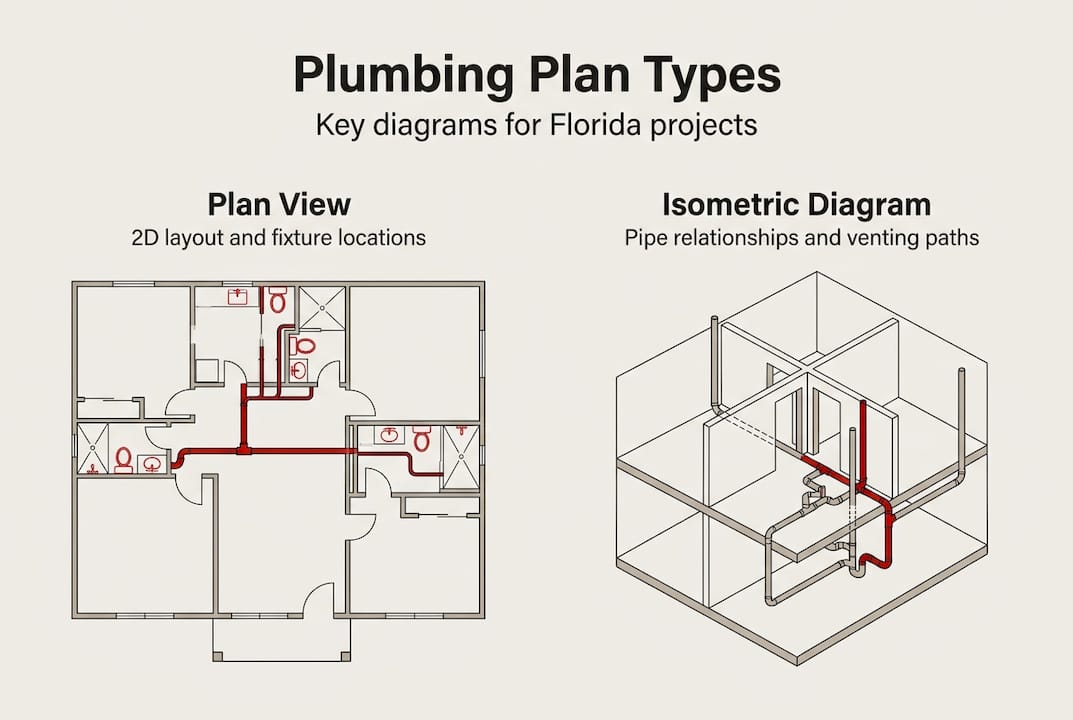
Pro Tip: Draft your isometric diagram alongside your plan view, not after. Catching a venting conflict in 3D early saves you from redrawing the entire plan view later.
For a full walkthrough of what happens after your plan is ready, the permit submission walkthrough covers the process from submittal to inspection. If your project involves mechanical or electrical systems too, MEP permitting advice explains how to coordinate all three disciplines.
Common mistakes and troubleshooting tips
Even experienced contractors make errors on plumbing plans. Knowing what to watch for saves you a resubmission cycle.
Common errors include omitting backflow preventers, mislabeling risers, improper slopes, not checking fixture units, or missing details required by local amendments. Here’s a breakdown of the most frequent problems:
- Guessing pipe sizes: Always use the IPC fixture unit tables. A 3-inch drain that should be 4 inches will fail inspection.
- Missing vents: Every fixture trap needs a vent. Forgetting even one creates a code violation.
- Skipping backflow preventers: Required on irrigation systems, hose bibs, and anywhere cross-contamination is possible.
- Ignoring local amendments: Florida counties add their own rules on top of the IPC. What’s fine statewide may be rejected locally.
- Not updating plans after field changes: If the plumber moves a stack during rough-in, the plan must reflect that. Outdated plans cause problems at resale and with insurance.
“The plan you submit and the system that gets built must match. Inspectors check both.”
Pro Tip: Build a simple checklist from your county’s submittal requirements and run through it before every submission. It takes 10 minutes and can save weeks of back-and-forth.
For a broader look at avoiding costly errors throughout the design process, design and permitting best practices covers the full picture from concept to approval.
Verification: Ensuring your plan meets Florida code and gains approval
Before you submit anything, run your own audit. Inspectors are looking for specific things, and knowing what they check puts you ahead.
Here’s a self-audit checklist before submission:
- Title block complete with project name, address, scale, and revision history
- All fixtures labeled with type and connection details
- DWV slopes shown and labeled at 1/4 inch per foot
- Pipe sizes confirmed using fixture unit tables
- Vent system shown with dashed lines and roof penetrations marked
- Backflow preventers shown at all required locations
- Legend included with all symbols defined
- Riser or isometric diagram included
- Local amendment requirements verified
Florida uses IPC with amendments and requires inspections at rough-in and final stages. Main compliance factors include pipe sizing by fixture units, flood-resistant design in coastal zones, and low-flow fixtures. Coastal projects face additional scrutiny because of flood zone regulations.
Permit applications must include a digital plan set, title block, revision history, scale, and detailed riser or isometric diagrams for most residential and all commercial work. If your project is commercial or involves a new system rather than a repair, a licensed professional engineer’s seal is typically required.
For projects that cross between residential and commercial thresholds, reviewing [residential vs commercial compliance](https://floridalicensedengineers.com/2026/01/18/residential-vs-commercial plans) standards helps you determine which rules apply before you finalize the plan.
Get expert help with your next plumbing plan or permit
Drafting a plumbing plan that passes Florida’s review process on the first submission takes more than good intentions. It takes accurate drawings, current code knowledge, and a clear understanding of what each county’s building department expects.

At Florida Licensed Engineers, we handle plumbing plan drafting, blueprint preparation, and permit submittal for residential and commercial projects across Florida. Whether you need a sealed set for a commercial build or a clean residential plan that clears review fast, our team knows exactly what Florida inspectors look for. Learn more about our full engineering services overview or explore the Florida blueprint process to understand what a professional plan set includes. Reach out for a consultation and get your project moving without the guesswork.
Frequently asked questions
What format do Florida counties prefer for plumbing plans?
Most counties require digital plans with a title block, scale, revision history, and often a riser or isometric diagram. Hand-drawn plans are rarely accepted for anything beyond the simplest residential repairs.
How do I size pipes correctly for my plan?
Use the IPC fixture unit tables to determine pipe diameter, and confirm that all drainage pipes slope at a minimum of 1/4 inch per foot. Guessing or using rule-of-thumb sizing is one of the top reasons plans get rejected.
Is it possible to draft my own plumbing plan without a professional?
Yes, for simple residential updates, a knowledgeable homeowner or contractor can draft a basic plan. However, complex systems, new construction, and commercial projects typically require a licensed engineer. Isometric diagrams in particular benefit from professional drafting for accuracy.
What are the most common mistakes people make when drafting plumbing plans?
The most frequent issues are improper slopes, missed venting, incorrect pipe sizing, and failing to account for Florida-specific local amendments. Running a checklist before submission catches most of these before they reach a reviewer.
Recommended
- Plumbing Plans for Florida Projects: What Matters Most – Florida Licensed Engineers
- Electrical Plans Process for Florida Construction Success – Florida Licensed Engineers
- Mechanical plans in Florida: essential guide for 2026 – Florida Licensed Engineers
- 7 Types of Plumbing Plans Every Contractor Should Know – Florida Licensed Engineers


